Buy Back Your Time: Difference between revisions
(→k1) |
|||
| (19 intermediate revisions by the same user not shown) | |||
| Line 4: | Line 4: | ||
*NOT an entry level business book. You can hire only when you have stable revenue, probably when you are around $1M | *NOT an entry level business book. You can hire only when you have stable revenue, probably when you are around $1M | ||
*Transcendence: maybe if someone is really good, they can 'hire to free up their time' without having revenue yet. That is probably called 'partnership' or 'cofounders' etc. Very difficult for extreme outliers. | *Transcendence: maybe if someone is really good, they can 'hire to free up their time' without having revenue yet. That is probably called 'partnership' or 'cofounders' etc. Very difficult for extreme outliers. | ||
*Workbook here - [https://www.buybackyourtime.com/resources] | |||
*Dan Martell is called '''Humanity's Biggest Cheerleader''' - https://www.danmartell.com/ | |||
=Preface= | =Preface= | ||
| Line 34: | Line 36: | ||
*James Clear - “Winners and losers have the same goals,” he writes. “You do not rise to the level of your goals. You fall to the level of your systems.” | *James Clear - “Winners and losers have the same goals,” he writes. “You do not rise to the level of your goals. You fall to the level of your systems.” | ||
*A '''Buyback Loop''' occurs as you continually '''audit''' your time to determine the low-value tasks that are sucking your energy. Then you '''transfer''' those tasks, optimally, to someone who’s better at them and enjoys them. Lastly, you '''fill''' your time with higher-value tasks that light you up and make you more money. Then you start the process over again. | *A '''Buyback Loop''' occurs as you continually '''audit''' your time to determine the low-value tasks that are sucking your energy. Then you '''transfer''' those tasks, optimally, to someone who’s better at them and enjoys them. Lastly, you '''fill''' your time with higher-value tasks that light you up and make you more money. Then you start the process over again. | ||
*Tom Clancy, one of the bestselling novelists of all time, employed writers to produce dozens of books under his name over the last two decades of* | *Tom Clancy, one of the bestselling novelists of all time, employed writers to produce dozens of books under his name over the last two decades of his career. | ||
*[[File:buybackloop.png|200px]] | |||
*Or look at Warren Buffett. He spends his time on two primary tasks: reading books and searching for the next investment opportunity. His Berkshire Hathaway empire is approaching $1 trillion in value and employs nearly four hundred thousand people around the world. | |||
*'''Audit''': What tasks do I hate doing that are easy and inexpensive to offer someone else? '''Transfer''': Who do I have on my team—or who can I hire, even part-time—to take these over? '''Fill''': What tasks should I focus on that I love doing that can immediately bring more money to my company? | |||
==Summary== | |||
# The Buyback Principle: Don’t hire to grow your business. Hire to buy back your time. | |||
# You can’t personally outwork yourself to a better business. The problem is you only have twenty-four hours a day. Eventually, if you’re doing everything, you (or one of your relationships) will break down. | |||
# If you keep grinding, you’ll eventually hit the Pain Line, where you’re experiencing so much pain when you try to grow that you’ll do one of three things: stall it, sabotage it, or sell it. | |||
# When you hit the Pain Line, it should act as a feedback loop—this is your opportunity to embrace a new mindset or to continue on in the status quo, waiting for something to snap. | |||
# A Buyback Loop occurs as you continually audit your time to determine the low-value tasks that are sucking your energy. Then you transfer those tasks, optimally, to someone who’s better at them and enjoys them. Lastly, you fill yo | |||
=k2= | |||
*If hire out to do 80%, when is 80% insufficient? | |||
=Intended Outcomes= | =Intended Outcomes= | ||
*What do you do when it is difficult to hire for the specific thing you need? Such as if nobody can do it? Keep doing -> then train someone from scratch? | *What do you do when it is difficult to hire for the specific thing you need? Such as if nobody can do it? Keep doing -> then train someone from scratch? | ||
*Be careful about self-sabotage with growth. Pain Line - subconsciously keep from pain by sabotage. | *Be careful about self-sabotage with growth. Pain Line - subconsciously keep from pain by sabotage. | ||
*Hire somebody in customer support way more empathic than I and shoot customer service way up | |||
*Speechwriter to synthesize presentations more powerfully than I | |||
*Product developer better than I to handle due diligence, where i provide only systems design. | |||
*Transition fully to systems design, to partake in usufruct of finished products that I can use (CNCs, cars, open source private jet, microchip fab, good food, lifetime products, etc) | |||
=Outsourcing at Different Rates= | |||
= What You Should Outsource Immediately at $50k/year (≤ $6/hr) = | |||
At $50k/year, your approximate effective rate is ~$25/hour, and your '''Buyback Rate''' is ~'''$6/hour'''. Any task you can outsource competently for ≤ $6/hour should be transferred off your plate if it is not in your Production quadrant. | |||
* '''Inbox triage, basic scheduling, and simple calendar updates''' (virtual assistant) | |||
* '''Expense entry, receipt sorting, basic bookkeeping prep''' (bookkeeping assistant; keep CPA for oversight) | |||
* '''Document formatting, wiki/content cleanup, file organization''' (virtual assistant) | |||
* '''Simple social media posting, caption formatting, content scheduling''' (content VA) | |||
* '''Customer support triage, FAQ replies, ticket routing''' (part-time VA or intern) | |||
* '''Research, vendor lookups, price comparisons, order preparation''' (procurement/admin) | |||
* '''Website backups, plugin updates, basic maintenance''' (low-cost web ops or intern) | |||
If any of these still sit on your plate, you are effectively paying ~$25/hour for work the market will reliably deliver at ~$3–$6/hour. Even freeing 5–10 hours per week and redeploying that time into your highest-leverage design, strategy, partnerships, and system-architecture work can materially accelerate revenue and organizational capacity at this income level. | |||
= What You Should Outsource Immediately at $500k/year (≤ $62/hr) = | |||
At $500k/year, your approximate effective rate is ~$250/hour, and your '''Buyback Rate''' is ~'''$62/hour'''. Any task you can outsource competently for ≤ $62/hour should be transferred off your plate if it is not in your Production quadrant. | |||
* '''Inbox, scheduling, calendar, and travel''' (executive assistant / operations admin) | |||
* '''Bookkeeping, invoicing, payroll prep, expense categorization''' (bookkeeper; keep CPA for oversight) | |||
* '''Document formatting, wiki/content cleanup, file organization, data migration''' (virtual assistant or ops contractor) | |||
* '''Social media posting, basic video editing, podcast coordination, newsletter ops''' (content ops) | |||
* '''Customer support triage, ticket routing, FAQ responses''' (support lead or part-time VA) | |||
* '''Research, vendor sourcing, price comparisons, order placement''' (procurement/admin) | |||
* '''Website maintenance, backups, routine updates, non-architectural IT tasks''' (web ops) | |||
If any of these still sit on your plate, you are effectively paying ~$250/hour for work the market will reliably deliver at ~$10–$40/hour. Freeing even 10–15 hours per week and redeploying that time into your highest-leverage design, strategy, partnerships, and system-architecture work will compound both revenue and organizational capacity. | |||
= What You Should Outsource Immediately at $5M/year (≤ $625/hr) = | |||
At $5M/year, your approximate effective rate is ~$2,500/hour, and your '''Buyback Rate''' is ~'''$625/hour'''. Any task you can outsource competently for ≤ $625/hour should be transferred off your plate if it is not in your Production quadrant. At this level, your job is enterprise architecture, capital allocation, strategic partnerships, and vision—not operations. | |||
* '''Inbox management, scheduling, calendar ownership, and all travel''' (senior executive assistant / chief of staff) | |||
* '''All bookkeeping, accounting, payroll, expense management, and reporting''' (CFO or fractional CFO team; CPA for compliance only) | |||
* '''Contract drafting, routine legal review, compliance filings''' (in-house counsel or outside legal team) | |||
* '''Hiring pipelines, onboarding systems, performance management, HR administration''' (HR director or PEO) | |||
* '''Customer support leadership, ticket systems, escalation handling''' (support director and operations team) | |||
* '''Marketing execution: content production, video editing, social publishing, email/newsletter ops, ad management''' (marketing director and content team) | |||
* '''Sales operations: CRM management, pipeline reporting, proposal generation, contract administration''' (sales ops lead) | |||
* '''IT operations: website maintenance, backups, security, infrastructure, helpdesk''' (IT manager / MSP) | |||
* '''Procurement, vendor negotiations, purchasing workflows, inventory systems''' (operations director) | |||
* '''Project management, delivery tracking, internal reporting''' (PMO or operations manager) | |||
* '''Research, market analysis, competitive intelligence, data preparation''' (strategy or analytics team) | |||
If any of these are still on your plate, you are effectively paying ~$2,500/hour for work the market can reliably deliver at a fraction of that cost. Freeing even 10–20 hours per week at this level and redeploying that time into your highest-leverage activities—vision, capital strategy, institutional design, partnerships, ecosystem building, and platform architecture—creates orders-of-magnitude impact on organizational scale, resilience, and mission execution. | |||
=Links= | |||
*10x vision map - [https://docs.google.com/presentation/d/1FXde0FfUeliFBuzE7r9LR4oHMqLqlh9krQ9AULDReRk/edit?slide=id.g3b6a2c99f35_0_0#slide=id.g3b6a2c99f35_0_0] | |||
=Strategies= | =Strategies= | ||
*'''Stacking Functions''' - Partner with someone who does something for you for free because they offer complementary services (they ride on your coattails) | *'''Stacking Functions''' - Partner with someone who does something for you for free because they offer complementary services (they ride on your coattails) | ||
Latest revision as of 19:01, 14 January 2026
About
- From The Only Productivity Books Entrepreneurs Need In 2026:
- PDF online - https://library.grinternationalschool.co.in/wp-content/uploads/2025/02/Buy_Back_Your_Time_-_Dan_Martell-340-1.pdf
- NOT an entry level business book. You can hire only when you have stable revenue, probably when you are around $1M
- Transcendence: maybe if someone is really good, they can 'hire to free up their time' without having revenue yet. That is probably called 'partnership' or 'cofounders' etc. Very difficult for extreme outliers.
- Workbook here - [1]
- Dan Martell is called Humanity's Biggest Cheerleader - https://www.danmartell.com/
Preface
'LEARNING HOW TO buy back my own time has created an incredible life. This week I’ll spend six hours growing my eight-figure business. I’ll train for an Ironman. I’ll volunteer with inner-city youth. I’ll write my next book. I’ll look for my next investment. I’ll give my attention and resources to the atrisk entrepreneurs who give me so much energy and joy. Best of all, I’ll spend time with my kids, eat lunch with my wife, and the four of us will enjoy dinner together . . . every night. None of that has come because I simply grinded harder. All of it has come because I learned to think and act differently inside my company, so that every moment invested in it has allowed me to withdraw more energy from it.'
k1
Goals are about the results you want to achieve. Systems are about the processes that lead to those results. —james clear[1]
The little-known secret to reaching the next stage of your business is spending your time on only the tasks that: (a) you excel at, (b) you truly enjoy, and (c) add the highest value (usually in the form of revenue) to your business. Likely, two to three tasks fit that description. Every other task you’re handling is slowing your growth and sucking the life from you, and you should clear it from your calendar. Yes, someone else should be handling about 95 percent of your current work so you can get back to what matters.
- Ok, but BS. What if you ARE better than anyone else around you at multiple tasks, including ones that don't give most energy? and instead just consider how you’d feel if you were only executing what you’re better at than everyone else, what you truly love, and what adds a crazy amount of value to your business.. Key is there - better than anyone else AND truly love at the same time.
- Buyback Principle - That’s what the Buyback Principle is all about: 1. How to spend the most finite asset your business possesses: the founder’s time. 2. How to invest that time into what will bring the founder more energy and more money. Hiring is reinvestment - critical thing is to hire specifically to buy back time. In short: The Buyback Principle: Don’t hire to grow your business. Hire to buy back your time.
- Typical objections - I don’t have the time. I can’t afford the help. No one’s as good at the work as I am. No one wants to do the work. I can’t find good people to hire.
- James Clear - “Winners and losers have the same goals,” he writes. “You do not rise to the level of your goals. You fall to the level of your systems.”
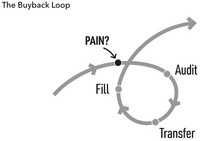
- A Buyback Loop occurs as you continually audit your time to determine the low-value tasks that are sucking your energy. Then you transfer those tasks, optimally, to someone who’s better at them and enjoys them. Lastly, you fill your time with higher-value tasks that light you up and make you more money. Then you start the process over again.
- Tom Clancy, one of the bestselling novelists of all time, employed writers to produce dozens of books under his name over the last two decades of his career.
- Or look at Warren Buffett. He spends his time on two primary tasks: reading books and searching for the next investment opportunity. His Berkshire Hathaway empire is approaching $1 trillion in value and employs nearly four hundred thousand people around the world.
- Audit: What tasks do I hate doing that are easy and inexpensive to offer someone else? Transfer: Who do I have on my team—or who can I hire, even part-time—to take these over? Fill: What tasks should I focus on that I love doing that can immediately bring more money to my company?

Summary
- The Buyback Principle: Don’t hire to grow your business. Hire to buy back your time.
- You can’t personally outwork yourself to a better business. The problem is you only have twenty-four hours a day. Eventually, if you’re doing everything, you (or one of your relationships) will break down.
- If you keep grinding, you’ll eventually hit the Pain Line, where you’re experiencing so much pain when you try to grow that you’ll do one of three things: stall it, sabotage it, or sell it.
- When you hit the Pain Line, it should act as a feedback loop—this is your opportunity to embrace a new mindset or to continue on in the status quo, waiting for something to snap.
- A Buyback Loop occurs as you continually audit your time to determine the low-value tasks that are sucking your energy. Then you transfer those tasks, optimally, to someone who’s better at them and enjoys them. Lastly, you fill yo
k2
- If hire out to do 80%, when is 80% insufficient?
Intended Outcomes
- What do you do when it is difficult to hire for the specific thing you need? Such as if nobody can do it? Keep doing -> then train someone from scratch?
- Be careful about self-sabotage with growth. Pain Line - subconsciously keep from pain by sabotage.
- Hire somebody in customer support way more empathic than I and shoot customer service way up
- Speechwriter to synthesize presentations more powerfully than I
- Product developer better than I to handle due diligence, where i provide only systems design.
- Transition fully to systems design, to partake in usufruct of finished products that I can use (CNCs, cars, open source private jet, microchip fab, good food, lifetime products, etc)
Outsourcing at Different Rates
What You Should Outsource Immediately at $50k/year (≤ $6/hr)
At $50k/year, your approximate effective rate is ~$25/hour, and your Buyback Rate is ~$6/hour. Any task you can outsource competently for ≤ $6/hour should be transferred off your plate if it is not in your Production quadrant.
- Inbox triage, basic scheduling, and simple calendar updates (virtual assistant)
- Expense entry, receipt sorting, basic bookkeeping prep (bookkeeping assistant; keep CPA for oversight)
- Document formatting, wiki/content cleanup, file organization (virtual assistant)
- Simple social media posting, caption formatting, content scheduling (content VA)
- Customer support triage, FAQ replies, ticket routing (part-time VA or intern)
- Research, vendor lookups, price comparisons, order preparation (procurement/admin)
- Website backups, plugin updates, basic maintenance (low-cost web ops or intern)
If any of these still sit on your plate, you are effectively paying ~$25/hour for work the market will reliably deliver at ~$3–$6/hour. Even freeing 5–10 hours per week and redeploying that time into your highest-leverage design, strategy, partnerships, and system-architecture work can materially accelerate revenue and organizational capacity at this income level.
What You Should Outsource Immediately at $500k/year (≤ $62/hr)
At $500k/year, your approximate effective rate is ~$250/hour, and your Buyback Rate is ~$62/hour. Any task you can outsource competently for ≤ $62/hour should be transferred off your plate if it is not in your Production quadrant.
- Inbox, scheduling, calendar, and travel (executive assistant / operations admin)
- Bookkeeping, invoicing, payroll prep, expense categorization (bookkeeper; keep CPA for oversight)
- Document formatting, wiki/content cleanup, file organization, data migration (virtual assistant or ops contractor)
- Social media posting, basic video editing, podcast coordination, newsletter ops (content ops)
- Customer support triage, ticket routing, FAQ responses (support lead or part-time VA)
- Research, vendor sourcing, price comparisons, order placement (procurement/admin)
- Website maintenance, backups, routine updates, non-architectural IT tasks (web ops)
If any of these still sit on your plate, you are effectively paying ~$250/hour for work the market will reliably deliver at ~$10–$40/hour. Freeing even 10–15 hours per week and redeploying that time into your highest-leverage design, strategy, partnerships, and system-architecture work will compound both revenue and organizational capacity.
What You Should Outsource Immediately at $5M/year (≤ $625/hr)
At $5M/year, your approximate effective rate is ~$2,500/hour, and your Buyback Rate is ~$625/hour. Any task you can outsource competently for ≤ $625/hour should be transferred off your plate if it is not in your Production quadrant. At this level, your job is enterprise architecture, capital allocation, strategic partnerships, and vision—not operations.
- Inbox management, scheduling, calendar ownership, and all travel (senior executive assistant / chief of staff)
- All bookkeeping, accounting, payroll, expense management, and reporting (CFO or fractional CFO team; CPA for compliance only)
- Contract drafting, routine legal review, compliance filings (in-house counsel or outside legal team)
- Hiring pipelines, onboarding systems, performance management, HR administration (HR director or PEO)
- Customer support leadership, ticket systems, escalation handling (support director and operations team)
- Marketing execution: content production, video editing, social publishing, email/newsletter ops, ad management (marketing director and content team)
- Sales operations: CRM management, pipeline reporting, proposal generation, contract administration (sales ops lead)
- IT operations: website maintenance, backups, security, infrastructure, helpdesk (IT manager / MSP)
- Procurement, vendor negotiations, purchasing workflows, inventory systems (operations director)
- Project management, delivery tracking, internal reporting (PMO or operations manager)
- Research, market analysis, competitive intelligence, data preparation (strategy or analytics team)
If any of these are still on your plate, you are effectively paying ~$2,500/hour for work the market can reliably deliver at a fraction of that cost. Freeing even 10–20 hours per week at this level and redeploying that time into your highest-leverage activities—vision, capital strategy, institutional design, partnerships, ecosystem building, and platform architecture—creates orders-of-magnitude impact on organizational scale, resilience, and mission execution.
Links
- 10x vision map - [2]
Strategies
- Stacking Functions - Partner with someone who does something for you for free because they offer complementary services (they ride on your coattails)