Concrete: Difference between revisions
Jump to navigation
Jump to search
| (15 intermediate revisions by 2 users not shown) | |||
| Line 18: | Line 18: | ||
*2500 PSI concrete minimum for slab on grade in Oregon - [https://www.co.douglas.or.us/building/INSPECT.gen.residential.info.htm] and Georgia [https://up.codes/viewer/georgia/irc-2012/chapter/4/foundations#4] | *2500 PSI concrete minimum for slab on grade in Oregon - [https://www.co.douglas.or.us/building/INSPECT.gen.residential.info.htm] and Georgia [https://up.codes/viewer/georgia/irc-2012/chapter/4/foundations#4] | ||
=Concrete | =Tools for DIY Mix= | ||
*Cement Mixer - [[File:landhonor.png|100px]] [https://www.moore-attachments.com/product/11097514/landhonor-cement-mixer-with-chute] | |||
*Industry standards - $175/yard delivered | |||
*Water source - | |||
*Forms - 2x4 + rebar stakes. | |||
*Concrete Bags - [https://www.menards.com/main/building-materials/concrete-cement-masonry/bagged-concrete-cement-mortar/c-5648.htm?inStockToday=true]. Need 60 per yard. $270 per yard. Weight is ~4000 lb/yard. 1 Yard is about 100 square feet. | |||
*Cement instead? | |||
*[[Solar Concrete]] is the answer | |||
*[[Cement Calculator]] - 3 yards for a 10' wide strip, 3", and 32" wide across hangar. | |||
*Moisture barrier - 6 mil poly | |||
*[[Steele Mixer]] | |||
=Challenges Introduced by the Curing Process= | =Challenges Introduced by the Curing Process= | ||
| Line 33: | Line 43: | ||
**Main downside is this takes away the advantage of not having to transport the giant [[Concrete Slab]] and just being able to move smaller bags or boxes or a [[Concrete Mixer]] etc | **Main downside is this takes away the advantage of not having to transport the giant [[Concrete Slab]] and just being able to move smaller bags or boxes or a [[Concrete Mixer]] etc | ||
**If designed properly, such as in the widespread use of Precast Concrete in the USSR such as [[Plita Aerodromnaya Gladkaya]] or [[Brezhnevkas]] etc it CAN be done | **If designed properly, such as in the widespread use of Precast Concrete in the USSR such as [[Plita Aerodromnaya Gladkaya]] or [[Brezhnevkas]] etc it CAN be done | ||
=Recordkeeping / Sample Collection= | |||
*For [[QC]] / [[QA]] / Inspections+Insurance | |||
==Concrete Slump Test== | |||
Measures inches of collapse, from 0-12", of a wad of concrete in a cone. 12" means it's complete water. 4" is very stiff. | |||
==Test Cores== | |||
*Cylinders of the same mix, cured then tested it estimate properties of the poured concrete | |||
===Lab Samples=== | |||
*Done at the point of mixing/cured+tested in a lab | |||
*Main downside is the controlled conditions of the lab may not match the conditions in the real world where the concrete cured | |||
===Field Samples=== | |||
*Cured “in situ” at the same place the concrete is being poured | |||
*Thus they account for any impacts of Temperature/Humidity | |||
**Also transport of the mix from the plant, if relevant. | |||
==Nondestructive Testing== | |||
*[[Concrete Visual Inspection]] / [[Concrete Nondestructive Testing]] | |||
=Internal Links= | =Internal Links= | ||
*[[Reinforced Concrete]] | *[[Reinforced Concrete]] | ||
=External Links= | =External Links= | ||
Latest revision as of 17:37, 5 December 2025
Basics
- The Combination of Aggregate and Cement
- It takes 5 94 lb bags of cement to make a yard of concrete [1]. In other words, a 50kW Solar Concrete plant will make a yard of concrete daily. Or, 10 days to make a slab foundation for Rosebud models of the Seed Eco-Home
Formula
- To make 1 yard - To make 1 cubic yard of concrete, you'd need seven 94-pound bags of cement, about 1/2 cubic yard of sand and just over 3/4 cubic yard of gravel. The amount of water you use depends on how wet the sand is.Oct 1, 2009 [2]
- 10% cement, 75% aggregate, 15% water [3]
- 150 kg/m3 of cement - with concrete at 4000 lb/cu yd [4] - was sufficient to get about 6000 psi concrete strength [5]. Does this mean abouut 8% of cement?
- 500 lb per yard of cement in concrete is recommended - read a thesis on it - [6]
- Lean or rich: 7-15% cement by volume -

- Lean concrete per california codes is 300 lb cement per yard of concrete, and is 700 PSI at 7 days. [7]
- Lean is used below foundations - and is 700 psi or 1100 psi [8]
Slab Requirements
Tools for DIY Mix
- Cement Mixer -
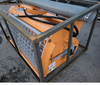 [11]
[11] - Industry standards - $175/yard delivered
- Water source -
- Forms - 2x4 + rebar stakes.
- Concrete Bags - [12]. Need 60 per yard. $270 per yard. Weight is ~4000 lb/yard. 1 Yard is about 100 square feet.
- Cement instead?
- Solar Concrete is the answer
- Cement Calculator - 3 yards for a 10' wide strip, 3", and 32" wide across hangar.

- Moisture barrier - 6 mil poly
- Steele Mixer
Challenges Introduced by the Curing Process
- Unlike Metal or Plastic or Dimensional Lumber , A Concrete Mixtures FINAL qualities will only be known once it cures
- The conditions in which the concrete cure also impact this
Potential Solutions
- ”Overbuild” such that even if a mix underperforms it still meets the required Concrete Specifications for that Concrete Mix
- Main Downside of this is Cost
- Thorough Recordskeeping + Concrete Tests
- Pre-Cast Concrete
- Rather than try and account for uncontrolled conditions…control the conditions
- Main downside is this takes away the advantage of not having to transport the giant Concrete Slab and just being able to move smaller bags or boxes or a Concrete Mixer etc
- If designed properly, such as in the widespread use of Precast Concrete in the USSR such as Plita Aerodromnaya Gladkaya or Brezhnevkas etc it CAN be done
Recordkeeping / Sample Collection
Concrete Slump Test
Measures inches of collapse, from 0-12", of a wad of concrete in a cone. 12" means it's complete water. 4" is very stiff.
Test Cores
- Cylinders of the same mix, cured then tested it estimate properties of the poured concrete
Lab Samples
- Done at the point of mixing/cured+tested in a lab
- Main downside is the controlled conditions of the lab may not match the conditions in the real world where the concrete cured
Field Samples
- Cured “in situ” at the same place the concrete is being poured
- Thus they account for any impacts of Temperature/Humidity
- Also transport of the mix from the plant, if relevant.
Nondestructive Testing
Internal Links
External Links
- The Wikipedia Page on Concrete
- YouTube Channel of Professor Tyler Ley
- A Video by the YouTube Channel Practical Engineering” Titled “Concrete’s Greatest Weakness is Time” ( ‘’’~17 Minute Watch’’’ )