|
|
| (360 intermediate revisions by 2 users not shown) |
| Line 1: |
Line 1: |
| =Potential Editors=
| | '''aka Open Source Ecology: a Case for Abundance''' |
| [[Potential Editors]]
| |
| =Book Log=
| |
| *[[Book Log]]
| |
|
| |
|
| =Main Doc= | | =Big Idea= |
| https://docs.google.com/document/d/12v-keaJeZvdZ-uong3l9ww2NaS1-3eh7vbOf0Z6McoA/edit
| | *Civilization 101 experiments as a parallel paradigm in civilization. All the good places are taken, though? Wrong! Explain why that is not the case, and opportunity abounds. |
|
| |
|
| =Open Source Microfactory Chapter= | | =Approaches= |
| *Doc | | *Each chapter or section is an area of human endeavor. We start with status quo, and weave a credible path to transcendence or inspiration on each. This is consistent with our art of possibility, creative approach, with 100x breakthrough. |
| - [https ://docs.google.com/document/d/1SQQ1v47bODnPC0fR6xTU9RwJHeLfhK7HovvMGANZwPc/edit]
| | *Unconventional view worth critiquing, not herd messaging. [[Upside Down]]. |
| *Add open source Waterjet to system. Needs high pressure hydraulic power SMEs to be added to the team. | | *Collaborative everywhere - we are all in it together |
| | *Radical real inspirations sprinkled throughout. |
|
| |
|
| =Notes= | | =Structure of Book= |
| *O'Reilly - [https://www.inc.com/magazine/20100501/the-oracle-of-silicon-valley.html] | | *https://chatgpt.com/share/69b9e48c-02ac-8010-bfce-497e31e6e2e2 |
| <html><iframe src="https://docs.google.com/presentation/d/e/2PACX-1vTTc27t6wLThSPaqu81yzpPkJhFkMJLCvvJhm0s3KwqikzViqqsiUzs4VRp8u89D_Y521NZ7HKyi_2A/embed?start=false&loop=false&delayms=3000" frameborder="0" width="960" height="569" allowfullscreen="true" mozallowfullscreen="true" webkitallowfullscreen="true"></iframe></html>
| | *Invitation to 18-26 year olds to build a new civilization. Thus, the big ideas must resonate with intelligent young people. |
| | *Invitation to parents to encourage them |
| | *Expose cultural fit - beliefs and assumptions |
| | *Only builds upon industry standards - anything proposed is just an extension of an old idea (incremental approach) |
|
| |
|
| [https://docs.google.com/presentation/d/1mYpfR2xfmEZJaAKVybRH12YxglSYJrQ4YS9IAWPyBc8/edit#slide=id.g2ceb325cf7_0_9 edit]
| | =Personal Intro= |
| | Unlimited power and responsibility for everyone. Except nobody wants it. Give examples. This book is an invitation to those who do, for benefit of all humanity and to conquer evil for the next millennium. |
|
| |
|
| =Strategy= | | =Introduction= |
| | Book-Website-Apprenticeship-Podcast |
|
| |
|
| ==General==
| | We may be at a turning point in humanity. There is a crisis of meaning. People are disconnected from nature or from raw survival by building things. With AI emerging as a potential threat - and promise - we take 2026 to attemp the OSE Model of Change. Our model is to train oodles of young people to be system transformers, veritable civilization systems engineers - using collaborative and open source methods. Many outdated institutions need updating, so we take this as a chance to do massively positive work with purpose. Some clear areas are solving meaning, housing, energy, manufacturing, environmental issues such as various extinctions, governance, and social justice issues. |
| Book-'''Podcast''' with Notable Book Assets-Book Tour/Workshop Tour-SME Recruiting of Key Assets-'''Visiting With''' Key Contacts for Collaboration Development-'''Dedicated Project Visits'''- '''Entrepreneur Immersion Training'''-Book Contributions Crowdsourced for Society Painpoints on top of the mainstream published views-Business Dev Design Sprints-Design Guide Book Sprints-FreeCAD Workbench Design Blueprints
| |
|
| |
|
| ==Specifics==
| | We begin with topics such as housing, energy, agriculture, and manufacturing - absorbing the primary sector of the economy and working on collaborative methods to rebuild the world. We found a revenue model on hyper-efficient construction, so we are starting an induction where students build homes 2 days and spend the rest of the time learning how to transform the world. We are also developing a [[Degenerate]] kernel for modular technology, the [[Global Village Construction Set]]. To democratize design so that average people can design and build engineered technology - we are introducing the Iconic CAD Workflow - which leverages human language and AI to generate real design in FreeCAD - along with all the documentation to to make design replicable and contribution scalable. |
| As a blueprint, the book can be used in these ways:
| |
| #Book can be refactored to identify specific SMEs. Then recruiting team can search for the SMEs, invite them, onboard them. OSE Dev Team works with SMEs. Summer program calls upon SMEs for a 1 hour Q&A.
| |
| #Book is refactored for proposals (product ecology designs with basic business models), student research projects (masters and PhD), and operations plans for various enterprises. Enterprises are tested as one month [[Dedicated Project Visits]].
| |
| #Outcome of book is an advanced team ecology for development teams - for regular Design Sprints. A new FreeCAD in 1 Hour video would be required to get people to learn FreeCAD in about an hour.
| |
| #Outcome is an [[Business Development Design Sprint Protocol]] and a [[Book Sprint Protocol]].
| |
|
| |
|
| =Machines and Primitives= | | =The Story= |
| | Will AI bring the last economy of apocalypse, or abundance? It's up to us. |
|
| |
|
| <html><iframe src="https://docs.google.com/presentation/d/e/2PACX-1vQPdgqOL5Je_YkFf43eo9IShCcfom0yWkpH2NkODeIj1T4fh303ig4Ny9Maurr8Nc38hvuGWIPJyCG8/embed?start=false&loop=false&delayms=3000" frameborder="0" width="960" height="569" allowfullscreen="true" mozallowfullscreen="true" webkitallowfullscreen="true"></iframe></html>
| | This is a book about transformative, immersion education. It is for people who want to apply their education to.solving pressing world issues, not becoming a part of the problem. |
|
| |
|
| [https://docs.google.com/presentation/d/15ai0IWG8uIi82E3H0a1geCrl5kKBqTg5bibvh_fRXJI/edit#slide=id.g2d05992bc3_0_12 edit]
| | Explain what the problem is: fundamentallg broken large-scale paradigms and institutions. Our proposal is to rebuild them. |
|
| |
|
| =Positioning=
| | Open source,inexpensive, replicable where every person can access the tools to design and build. Your house. Your car with a hydrogen burning clean engine. Your consumer goods with lifetime design. |
|
| |
|
| *'''Introduction''' - frame it around the economy of access. Could start with TED Talk. A new civilization for $10k. Induction furnace + 3D printer, and we are good to go. $2k induction furnace. Scrap metal.
| | [[OSE Positioning]] |
| *'''50 Machines''' – machine groups.
| |
| :*Product groups + insights about other companies to give perspective. Such as hydrogen vs electric, biomass vs electric, solar tranisition (cheap PV), cars (the superefficient single commuter), batteries towards [[ZMCS]] - nickel iron?
| |
| :*IoT Housing 2.0 – microfactory, energy plant, food production aquaponics in an energy/manufacturing/food production internet.
| |
| :*Materials Production Facility – Biofuel + biomaterials and carbon negative concrete. Charcoal, insulation, bioplastic, semiconductors. Discuss zone refining of silicon. 8000 sf produces biofuel, concrete, steel, insulation, charcoal, induction glass furnace, bricks, lumber, and semiconductors.
| |
| :*Energy Internet – excess PV house or microfactory power goes to producing hydrogen. Compressed biogas runs cars. Nickel iron batteries are the Power Wall 2.0 based on lifetime design. insights on biomass vs electric vs hydrogen vs compressed methane
| |
| :*Aquaponic Greenhouse – and Farmbot for seeding, Drones for planting, and last mile delivery of produce.
| |
| :*Agriculture – ROS + heavy equipment
| |
| :*Advanced - aluminum from clay and SiO2 sand to PV. Just needs some energy from the Open Source
| |
| *'''Ramifications''' - Appropriate Technology, End of Work, Abundance or Existential Crisis, Singularity, ZMCS, Experience Economy, Sharing Economy, New Commoners, New Contracts (smart contracts), New Money (blockchain)
| |
| :*Integrating all known trends into a cohesive picture, paving the way for OSE implementation
| |
| :*Becoming the greatest unemployer in the world. Boss employee relations. '''Critical''': statistics on demonetization? Statistics on 'employment'? Is the Paradox of Capitalism being realized?
| |
| *'''How to Get There'''
| |
| :*Development Process: OSPD, Extreme Design, Extreme Manufacturing, Extreme Recruiting
| |
| :*OS Microfactory with Energy Internet. Internet of production and logistics. Remote Control Print+automate harvest+UPS truck.
| |
| :*How OSE is levearaging crowdsourcing, singularity, automation, AI, 3D printing, MOOCS, Buying out at the Bottom (BOAB), ZMCS, Experience Economy, Sharing Economy, open source microfactories, smart contracts, and crypto coins to create the open source economy.
| |
| :*$10k + Civilization Starter Kit DVD by 2029. $100k upsell for the Quick-Start Package. $1M for a new small scale republic. Freedom is not for sale.
| |
|
| |
|
| =Appendix= | | =Crisis of Meaning= |
| *P567 MJ24
| |
| *Legal structure for optimizing the commons: infinite scalability of the open source economy
| |
| :*Employees vs partners
| |
| :*Franchise model
| |
| :*Owner operator model + startup
| |
| :*Value differentiation - open supply chain, open design, open enterprise, open training - for a Distributive Enterprise.
| |
| :*Land based university model of the commons
| |
| :*Triple + 1 revenue model - education immersion, production during training, XM workshop - product + tuition
| |
| :*Open enterprise model of commons marketing - swag, infoproducts, infofacture, kits, products
| |
| :*Risk - Amazon. They will go open source.
| |
| :*Scale of University Education sector
| |
| =Appendix 2=
| |
|
| |
|
| =Abstract for Extreme Development chapter=
| | Goal is to communicate that we can get over as a society over the deathly fear of learning integrated learning and AI. Which is what AI requires that we become integrated humans in order to collaborate favorably with technology. Otherwise AI will eat humanity, intensifying the current curse of advanced technology being developed with limited human wisdom and limited ethics. |
| Integrate all human knowledge on collaborative development and relate to OSE’s Extreme Development – Extreme Design and Build. Make a case for our work based on known techniques that are already known and prior literature:
| |
| | |
| *Wikipedia – unmanaged contributions improve themselves, a la Clay Shirky, Here Comes Everybody
| |
| *Bold – crowd funding, crowd design, incentive prizes – HeroX, X Prize. MTP by Diamandis.
| |
| *Appropriate technology – Gandhi, Schumacher, Rifkin – Zero Marginal Cost Society (ZMCS)
| |
| *Flexible Manufacturing – Piore
| |
| *Rifkin – ZMCS, referring to Adam Smith et al on the Dilemma of Capitalism. Supported by 6Ds of Diamandis, but need some numbers to verify
| |
| *Kurzweil – Singularity when computer power overpowers
| |
| *Moore’s Law
| |
| *Law about doubling of installed PV reduces cost by 20%
| |
| *Modular, open source design – the latest in Product Development Literature
| |
| *Going from 13% to 40% overall energy efficiency – Rifkin
| |
| *Even Amazon admits that the future of its Fulfillment Centers will be Microfactories
| |
| *But open source, collaborative is key- as that can be the balancing force. Discuss fake open source – Tesla?
| |
| *Collaborative commons will eclipse Capitalism by 2050
| |
| *FabLabs – digital fabrication towards the open source microfactory. Many organizations have proposed the microfactory vision. However, their proprietary nature introduces competitive waste, such as the LocalMotors enterprise – which means it will deliver only a part of the zero marginal cost promise. Other efforts, such as OpenMotors – rel
| |
| *Aggregation platforms will survive, such as Uber, or Amazon logistics of same day product delivery. But rest will enter zero marginal cost regime.
| |
| *OSE Value Add – Extreme Builds – very efficient. Combines crowd build and digital fabrication
| |
| | |
| =Links=
| |
| [[Book Log]].
| |
| | |
| =Text=
| |
| | |
| | |
| | |
| | |
| | |
| ToC
| |
| | |
| Foreword
| |
| My history. Poland. Until I discovered...that I was useless.
| |
| Introduction
| |
| Society’s infrastructures and why they are important: physical, and information physical
| |
| Assessement of abundance and doom
| |
| Abundance, Homo Deus, climate change, diseases, pollution, war, poverty. History of enclosure (ZMCS + TRAGB)
| |
| Numeracy, with feelings. You have to understand basic principles, and graphs will lie to you if you let them.
| |
| Understanding possibilities - bad chemicals to good chemicals, evil process to good process, disintegrated to integrated, closed to open,
| |
| How to create abundance: Societal issues related to the material base vs. information economy vs need to evolve as humans
| |
| GRAT Best writing and perspectives on what does work in society today
| |
| The limits of dematerialization: limit of economy is not information but information physical, and the essential question of lifetime design. Scarce resources and scarce information. In the limit, information is abundant (open source)
| |
| Ethics of scarce information. Perversion of the ‘open letter’. Patent system and proprietary development. Nobody has shown to date that patents increase innovation.
| |
| Open source. What is it? Difference between open source hardware and free-design hardware
| |
| Why CC-BY-SA coercion is libertarian. Say what? Revolves around preventing enclosure.
| |
| Difference between open source and free/libre
| |
| How GPL can protect you when you break DRM?
| |
| The GVCS: What is it. Why the experiment? Applications. Resilience. Disaster. Space. World Fix. GVCS top 12.
| |
| How the GVCS was selected. Metrics: performance. Minimum Set for Completeness. Substitutability. Scalability. Modularity. Lifetime design. Ecological. Universal Constructor.
| |
| Approach: machines, derivative machines, products of machines, and systems. Product Ecologies
| |
| The GVCS Experiment: we can make the road only by walking. Choice is not set in stone, and one size will not fit all.
| |
| GVCS
| |
| About The Machines and Products of the Machines
| |
| About The Derivative Machines
| |
| About The Systems
| |
| About Product Ecologies
| |
| Housing
| |
| Food
| |
| Energy
| |
| Transportation
| |
| Manufacturing
| |
| The End State
| |
| End End State
| |
| Getting There - $1B
| |
| OSE Appropriate Technology
| |
| History of AT
| |
| OSE OSAT
| |
| OSE Specifications
| |
| Dunbar scale. Village of tomorrow is where you and your clan live. The city is a collection of Global Villages
| |
| Open Source
| |
| Ecological
| |
| Human Scale
| |
| Simple, Scalable, Modular
| |
| Distributive. Distributive Enterprise.
| |
| Pattern language and construction set
| |
| Top 24 icons
| |
| 120 Icons for Civilization - parts and mechanisms
| |
| Technological Recursion: down to silicon from sand and aluminum from clay
| |
| Applying OSE Specifications to any technology
| |
| Product Ecologies: living and working ecosystems
| |
| The cookie cutter development for consumers vs. the live lifestyle. Gummit and Admin lifestyle vs R&D&G lifestyle of constant growth.
| |
| Towards Prosumers
| |
| Towards the OSE Prosumers
| |
| Different systems: house, microfactory, greenhouse, materials
| |
| Details of complete ecologies - see Appendix
| |
| Development Approach:
| |
| Agile: Crowdsourced and Blockchained Heavyweight Product Management. OSPD. Industry standards for product development.
| |
| 100x on Design, Build, and Organization.
| |
| Extreme Manufacturing. 6 milestones reached.
| |
| Design & Build
| |
| Organization and enterprise. We built machines...and then we sold them. HR, Operations, Marketing. Automation, smart contracts, smart money.
| |
| Movement Entrepreneurship and solving pressing world issues
| |
| Startups and Finance Caital
| |
| Generally regarded existential risks: environment, war, poverty, corruption, wealth disparity, out-of-control technology
| |
| Solution: decentralization, transparency, integrated systems design, ethics, eco-technology, personal growth (general semantics, language, reason and spirituality)
| |
| Diffusion of Technology
| |
| Historical Trends of diffusion
| |
| Linux and Microsoft
| |
| What is different today, and what needs to happen still (evolution, distributive enterprise)
| |
| Scalability. MTP + Execution
| |
| Conclusion
| |
| Appendix
| |
| The specifics of OSE OSAT - the full OSE Specifications
| |
| The 50 Machines
| |
| Derivatives of the 50
| |
| Systems
| |
| Product Ecologies
| |
| Open Source Minimal Microfactory Product List (3DP, CNC Circuit Mill, and Filament Maker, and MicroPower Tool Construction Set)
| |
| Forward!
| |
| Here’s What we Propose - motivate those who have an open source ecology mindset. Align the contributors
| |
| Creating Civilization from Scratch - 1000 Global Villages
| |
| Enterprise Back End
| |
| Product Development
| |
| Scaling Model
| |
| | |
| | |
| Background Research
| |
| | |
| The End State
| |
| | |
| End State - Beginning - Solving the Compiler Dilemma - Narrow Compiler: the Open Source Microfactory - Broad Compiler: the Distributive Enterprise and the Incubation Support for Open Source Enterprises.
| |
|
| |
| End State
| |
| It takes only appoximately $1B per year to change a sector of the economy with open source development techniques. At least that is what Linux did. Linux currently receives $1B of software contributions per year. And linux and open source now dominates these major parts of the information economy in terms of market share: Cell Phones (80%, open source Android operating system); supercomputers (99% run Linux); servers (Apache open sourcce server is 46% of the market share with the next closest at 20%). Linux is only 3-5% of the desktop computer market share, with Microsoft being the great majority. However, the growth curve of the Linux market share appears to be in the deceptive exponential growth phase -
| |
|
| |
| Few people know it, but open source runs the information economy. Given that there are 8B mobile devices, and about 2B computers - then open source software is powering about 60% of the computing devices that people use.
| |
| | |
| The world of the information economy is open source - though the majority of the hardware world is quite proprietary.
| |
| | |
| Based on the model for computer software, we can model the rise of hardware. Here I make the proposition that by the time R&D of open source hardware infrastructures (homes, cars, agriculature, energy systems, etc.) reaches the $1B mark - the level currently enjoyed by Linux - then the economy will turn largely open source - just as the software economy today is largely open source. Linux started in 1991. OSE’s Global Village Construction set - an operating system for hardware - started in 2018, about 27 years after Linux. Today we are in the early days of open source ecology - the open source operating system for infrastructures.
| |
| | |
| Linux took about 20 years to attain the $1B annual development effort - with volunteers. Currently, Linux has 1400 full time equivalent volunteer developers. This is the model that we are adopting for OSE.
| |
| | |
| But the challenge for hardware is greater. We call it the Compiler Dilemma. While it is cheap to compile source code and run working programs - it is not cheap to compilethe source code of hardware - its design blueprints - to convert them to physical products. Electrons are cheap, but atoms are not.
| |
| | |
| In the software world, economic feedback loops of the software industry paid the developers for producing working code - now responsible for fueling large sectors of the economy:
| |
| | |
| From the Linux Foundation site -
| |
| Linux is the operating system for over 95% of the top one million domains
| |
| More than 80% of new smartphones sold run Android, which is based on the Linux kernel
| |
| All of the top 500 supercomputers in the world run on Linux
| |
| Most of the global markets run on Linux, including the New York Stock Exchange, NASDAQ, the London Exchange, and the Tokyo Stock Exchange
| |
| The majority of consumer electronics devices use Linux for its small footprint
| |
| More than 75% of cloud-enabled enterprises report using Linux as their primary cloud platform
| |
| Linux is the go-to infrastructure supporting the world’s ecommerce leaders, including Amazon, eBay, PayPal, Walmart, and others
| |
| | |
| We can in principle generate the source code for hardware inexpensively - the source code is design blueprints - which can be generated on a computer just as easily as software can be written - in terms on requiring no more than intellectual time and a computer powered by electricity.
| |
| | |
| For hardware - the challenge is compiling design into products: that is called manufacturing and production, which is typically capital intensive.
| |
| | |
| How to overcome this dilemma? The only way to overcome this dilemma is to provide economic feedback loops to the designers. In the computer world, software developers got paid by companies who wanted their product. In the hardware world, designers would also have to sell their designs. But because it is so expensive to compile the designs, there is a significant barrier to the development of working products, and to the resulting financial feedback loops.
| |
| | |
| This is a significant challenge, and it is a business problem. While a software guy can test their program and sell it - the cost for a hardware guy is higher.
| |
| | |
| This is where a company like Open Source Ecology - operating in the civic sector - plays a part. To succeed, this company must inherently develop not only the product - but the operations necessary to design, build, and test the products. Thus, an inherent part for any scalable open hardware project is that the project must develop its own operations - and elements related to running a typical enterprise with many moving parts.
| |
| | |
| That is the role that Open Source Ecology intends to play - to provide the design, build, testing, certification, and training for open hardware enterprises. The goal is nothing short of developing a scalable open source product development methodology - which would have a chance to compete as a free enterprise.
| |
| | |
| The success of open source hardware relies much more on a drive for entrereneurship rather than on a hobbyist effort. Because a hobbyist typically has another job so they can make a living. It is a core OSE belief that world transformation boils down to livelihood - what people do for a living. And we believe in right livelihood, in that what we do has to connect to ethical practice - meaning that in our choice of livelihood - we feed whatever global politic corresponds to that livelihood choice. From the open source ecology perspective, we care most about livelihoods that lead to a distributed, decent(ralized) economy - which doesn’t leave anyone behind. That means that we care about the environment as well.
| |
| | |
| The critical question for OSE is how to reach the $1B mark. If it took Linux 20 years, then we are on schedule to deliver the open source hardware domination by 2028. There is a decade left. I’ll report back in a decade in Towards the Open Source Economy, Part 2 - regarding whether we got there. If we double every year, we will be 1000x larger.
| |
| | |
| Why Did Linux Succeed
| |
| There were a numbe of other Unix projects that failed. Why did Linus succeed?
| |
| The operating system worked. Likewise, OSE must produce a working product up front. Then optimize the whole. Hence, we work with broad systems that work - the larger the better - but to enable working system, they have to be minimal.
| |
| It was written from scratch. Likewise, all OSE products are taken from scratch, but don’t throw out the baby with the bathwater as they build on industry standards.
| |
| It was integrated - many moving parts - unlike other utlilites in GNU which were standalone. The integration - into an actaul working product - is a huge value. For OSE, the integration is key - we are proposing an operatinig system - not individual parts, just like Linux.
| |
| It was a decentralized effort. But with heavyweight product management (linux approved all changes for a long time). Likewise, OSE uses Modularity to enable decentralization.
| |
| It switched to an open source-compliant license (free to use commercially). Likewise, OSE is open source to allow the next $1T economy.
| |
| Monolithic (what linux used) vs modular architecture did not seem to matter. OSE is modular, as it is more complex.
| |
| | |
| | |
| | |
| | |
| The Compiler Dilemma and 3D Printing of Practical Products
| |
| This
| |
| | |
| The Broad Compiler: Distributive Enterprise
| |
| | |
| This
| |
|
| |
|
| | The modern condition in the age of social media and AI can be understood as a systemic loss of meaning: people are increasingly unable to connect their effort to tangible, socially recognized outcomes that matter. This is not just psychological—it is structural. Education often produces abstraction without agency, institutions diffuse responsibility, and economic systems sever the link between work and visible contribution. The result is an “open loop” in human motivation: people act, but do not clearly see how their actions improve the world. At scale, this manifests as disengagement, anxiety, polarization, and even geopolitical instability—where scarcity mindsets and zero-sum systems contribute to conflict and stagnation. A world that cannot provide meaningful roles becomes brittle, reactive, and divided. |
|
| |
|
| | Open Source Ecology responds by building prototype communities of the future: campus-based, real-world environments where people collaboratively design, build, and operate the systems of everyday life—housing, energy, food, machines, and governance—as an integrated, open-source civilization. This is not abstract R&D; it is learning by building what matters, together, in the open, with immediate, visible results. But the deeper layer is human development: participants learn how to learn, how to think clearly, and how to act with integrity under real conditions. Through hands-on work and real feedback loops, people develop not just technical skill, but character—cultivating moral intelligence, emotional intelligence, intellectual rigor, practical (“primal”) capability, aesthetic sensibility, and the capacity for peak performance. Meaning is not taught; it is generated through contribution, responsibility, and visible impact in a living system. |
|
| |
|
| | The larger ambition is civilizational: to replace scarcity-driven systems with open, collaborative, abundance-oriented production by localizing the capacity to meet basic needs through shared knowledge and advanced, accessible know-how. By making it possible for anyone to participate in building and improving the physical and institutional infrastructure of life, OSE addresses the root drivers of conflict—resource insecurity, lack of agency, and absence of meaning—while unlocking higher levels of human potential. We start with the human spirit—service, growth, and responsibility—and build outward into systems that reflect those values. The result is a pathway toward a world where people are not passive participants in broken systems, but active co-creators of a thriving, peaceful, and purposeful civilization. |
|
| |
|
| Study of the System for Kindergarteners
| | =The Last Economy= |
| | Summarize a collapsed system based on the book, based on other historical like Roman, Easter Island, Mongol, or British. GDP measures destruction. Best things in life are free. Include a bunch of stuff from [[Upsdide Down]] by Galeano. |
|
| |
|
| Various Fictions of the Human Mind
| | =The Ethical Economy= |
| If somee social system is so complicated that a school child or kindergartener cannot understand it - then we may want to question why it exists in the first place. So let’s pass some systems through the Kindergarted Test - namely - the patent system, IPOs, the stock market, derivatives, country boundaries, newspaper and media, regulatory capture, taxation,political ponerology, and artificial intelligence as a potentially corrective force..
| | We could fix any global bad actor quickly 'if we had the political will'. No, if we behaved ethically. But - even now -US still buys about 1.2B of oil indirectly from Russia. |
|
| |
|
| Startup Capital
| | See [[The Ethical Economy]] by a recent Nobel Prize winner |
| Say you want to create the next trillion dollar enterprise sector. The typical route for world-impact projects is to invoke finance capital. The critical question for OSE scaling, through, it not about finance capital - but what resources that finance capital will buy. Thus, if we believe that you cannot buy the next trillion dollar economy - what can we substitute for finance capital? It is those resources that finance capital would buy.
| | =The Humane Society= |
| | Humanity already has sufficient technology to thrive. Creating access is more important than new technology. Explain this. [[From Counterculture to Cyberculture]]. Which is continued in [[Homo Deus]]. |
|
| |
|
| Those resources are people, operations, marketing, education - and the like - all the ingredients of a successful enterprise. OSE’s approach to minimizing financial costs of scaling is to provide open access and knowhow to scaling. By open source documentation - how do we facilitate efficient oerations, accounting, hiring, marketing, and education, to name a few aspects of a successful business?
| | Why never implemented? [[Most of What You Know Is Wrong]]. [[General Semantics]] proposes [[Civilization Engineering]] - an explicit program to improve humanity. [[Humanity+ vs Humanity-]]. Most of What You Know is Wrong - this comes out of philosophy, general semantics, cognitive theory, complexity theory, intelligent economics. Explain why this epistemic humility is required for creating emergent systems to transform the world |
|
| |
|
| Open sourcing these aspects could lead to great efficiencies. Imagine having the best mentor in the world helping you out - you as an open source entrepreneur - to navigate through startup and success. OSE can provide a number of open resources to faciliteate this, such as: operation manuals, proven business plans, project management templates, part libraries for design, website templates, collaborative product marketing, and many other resources.
| | =5 Key Infrastructures= |
| | Food-Energy-Housing-Education (rapid metalearning) -Governance (implemented at facility with voluntary contract) - these are the systems we model and practice in our community. Manufacturing is included in the first three. |
|
| |
|
| Let’s take a look at one scenario of the stratup costs of business that succeeds to the $100k-$1M/year level:
| | =5 Key Elements= |
| | Carbon (food), Hydrogen (energy), Silicon (energy, information, CEB), Calcium (housing), Iron (manufacturing). |
|
| |
|
| (case study of startup costs, tabulating BAU costs and Open Source Access costs) | | =State of the world= |
| | *Go through the 5 infrastructures above. Add environment - [[Green History of the World]]. Spell out modern education and governance as preparation for poverty and war. |
| | *Commie Capitalist Nazi Fascists - go through the political systems critique core of the lucid [[Escape from Capitalism]]. Commie experiment didn't work, as it was an implementation of state capitalism with power concentration and loss of agency greater than capitalism. Fascism is a method of imposing austerity (curbservices, raise taxes on the poor). Nazism abounds today in the form of very borders. Each is a substitute for an open and collaborative approach, which yet has no political name. Ask why none of these degenerated to open collaboration - why all mental models seem to aim at power concentration. Expose the mental model of scarcity (capital in capitalism, natural resources in progressive environemtalism) - both philosophies being scarcity-based. |
| | *The Last Class War - is onboarding to AI. This will divide the rich and poor further if unchecked. This class war is most interesting because it brings capital much closer to abundance, which would seem like it would up-end scarcity economics. But will it? |
|
| |
|
| Or an eneterprise that succeeds to the $10M-$100M level:
| | = state of the future world, i.e. where we want to go= |
| | *[[Advanced Security Policy]] |
|
| |
|
| (case study of startup costs, tabulating BAU costs and Open Source Access costs)
| | =What is Paradise= |
| | The dream, what everyone agrees on. Then what we do today. Solar hydrogen, steel, concrete. State this very non concretely so it a bomb of possibility. Includes 3 paradise levels - the practical case, the visionary case of clear abundance, and how automation will equalize this. |
|
| |
|
| The OSE approach is that thousands or millions of varied enterprises can start up at the above levels. A million $1M enterprises is a 1 trillion dollar open source sector - and a chance to normalize the collaborative economy. For reference, there are 15M millionaires in the world. The more millionaires the better. Greed? Not necessarily. A millionaire is someone who has assets of $1M or more. The nature of these assets is important. If the assets are used to serve others and make the world better, then that is a good thing
| | In nominal values, per capita global income is $14k, from a $117T pot - we are pretty poor all in all and this is very skewed because most people live on $2k/year. The model village is $4B economy for 10k people working 2 days per week? |
|
| |
|
| There are issues with finance capital. Finance capital is capable of propping up business and industries that do not grow on the virtue of their merit, but on the virtue of having lots of money thrown behind them. This is the dilemma of finance capital that we are trying to solve.
| | =The First Civilization= |
| | We are building the world's first community whose energy and cars are powered by solar solar energy and hydrogen - generated directly on site using open source electrolyzers. To through all areas: ag, housing, energy, manufacturing, health, education. governance and culture. |
|
| |
|
| Ok, thus, what is the case for IPOs. Pros: money. Cons: lose control, need to meet revenue goals leading to short-term thinking; and - a fundemental conflict of interest between investors and operators. The Investor’s goal is completely different than the operator’s goal. In sum, an IPO is “selling out” in the full negative sense of the word.
| | Go through each area in detail to extract the global picture. Such as industrial ag claim that we cannot feed the world without it. Go through the real truth about each, and show how we can address this at the 40 acre and 1000 acre scale. |
|
| |
|
| If trading volume matches and exceeds the size of global GPD, is there something wrong with this picture?
| | The first civilization refers to taking any subhuman infrastructure, calling it what it is, and moving forward with a solution whether distributed vertically integrated at and perennial poly culture with grass as fertilizer, with radical.closed loop cycle schemes. And implemented as a system anywhere. Solar hydrogen or plastic to fuel come to mind. We do this in school, so we start up an enterprise later within the 2 day cross-subsidy model. |
|
| |
|
| A case can be made that the thoroughly fucked up military industrial state is a result of short term thinking which may be attributed to the very structure of public corporations? First, what share of global revenue comes from publicly traded corporations?
| | Huge value can come from a rigorous treatment of each sector, intended for transformers. Those who tune out are not the audience. |
|
| |
|
| Thus, get rid of IPOs, and replace that with the OSPO - the Open Source Public Offering, or Initial Coin Offering, or other smarter contracts.
| | =Graduation into Civilization= |
| | Upon graduation, we build: |
| | #Functional communities built around lifelong education which are extr post eme to productive and unjobbed in the sense that people are pursuing their true calling. This is a hairyoneto explain. Post scarcity with high human skill augmented with powerful machines and open source intelligence. |
| | #Regen at vertically integrated ops with education, like White Oak Pastures etc - institutionalizing integrity |
| | #Integrity Builders - building regenerative communities in place of cookie cutter developments. Agrihoods, Fabulous Hoods, etc. |
| | #Intevrity Manufacturing with solar energy. New industry in the circular economy. |
| | #Etc |
|
| |
|
| OSPO. Just replace the financial requirements to those of long term goals, as well as full conrol by the company operators. That’s it. Is that possible? We could try. This is a great assignement for a Juris Doctor thesis. Today, the IPO has specific rules. Those rules are not natural laws - they are plain human fictions. Simpy replace the existing fiction with a new one with a couple of tweaks. That way, we are retaining accountability: operators are accountable to their baby (business they created) - and the investors are there only to help, not to rule the world. Thus, the IPO clauses mandating profit maximization are gone, and the world becomes a different place. This is an idea worth spreading. Does it collapse today’s capitalism? No, it just makes it more integrated, fair, and accountable. If this means that the company cannot raise a lot of capital - that is good. There is a check and balance for its growth, so it doesn’t grow like a cancer - but expands only on its merit.
| | While hundreds of such proposals have been made, we purpose a pattern for doing this inexpensively and replicably with open source. |
|
| |
|
| Capital In General
| | Here we provide a list of tangible infrastructures that many people can transition into building. |
| When raising capital (by taxation, IPO, or church tithes) - the question that one should ask is not how much captital is neede, but what are the goods and services that that capital will provide? To reduce those costs, we an ask, how can we prove those goods and services most efficiently? In order to reduce that capital requirement - ie, lower your taxes, or not lose control of your company through an IPO) - we simply ask - what is that capital buying you - and how does open source address lowering those costs?
| |
|
| |
|
| Take taxes and county roads. If we were to develop an open source robotic road grader, then the maintenance cost of roads decreases. We still need capital to buy and maintain a grader - but if open source lifetime design - can that cost be 10x less? So taxes go from 50% to a manageable 5% when extrapolated throughout the economy?
| | =GVCS= |
| | Goal is to produce a compelling narrative of the product ecology of the 50 tools and how they relate to the core of a new civilization plus the importance in terms of this displacing 11 trillion dollars of unsustainable activity and replacing with beauty. Another goal is to educate a little bit about relative abundance of materials and numeracy regarding abundance. Further to place this in the context of modular design and iconic CAD and construction sets. |
|
| |
|
| To achieve lower cost, we must ask systematically what the real costs are, and how open source efficiency reduces those costs drastically for everyone.
| | We are estimating an effort requirement of about 50000 hours to opensource and democratize each tool of the Global Village Construction Set, of which there are fifty. That is equivalent to the effort of about 24 people working full time for a y.ear, or a team of 24 providing the leadership of a 1000 more participants remotely, who can collaborate in a tightly-coordinated, [[Time-Binding]] way. 1000 people collaborating would mean 50% efficiency or better - or about 2 hours of volunteer time per day. Our dashboard would thus show 2 dials - one for 1000 contributors remote, and one for the 24 - if the dial is cranked up, we have a full effort. In full throttle, the team leads to productization, and billions of dollars distributed as the market size of each of the fifty is at least $1B, for more than $10T total. |
|
| |
|
| OSE Specifications
| | [[File:overdrive.jpg|200px]] |
|
| |
|
| Introduction. The OSE Specifications define the properties and qualities of products that OSE develops - as well as the processes that are used to develop the products. Based on the goal of creating an appropriate technology infrastructure for earth, the intent of OSE Specifications is to inform the practical design choices of products and systems. The OSE specifications are based on the concept of a minimum but sufficient technology set that allows humanity to thrive, serving as a basis for scientific and cultural advancement.
| | Appendix: each machine, rele dance, design, implementation and costing, automation capacity, |
|
| |
|
| The properties, qualities, and processes revolve around open source design.
| | Inc lude Tom's shoes model for housing. |
|
| |
|
| The OSE Specifications are designs to be complete and sufficient for informing design choices. Thus, based on a specific need - such as a bicycle - | | For example - housing is a rapid training RLF membership. The gym where you practice skills. And else have 1000 people going through the program each year. 10 facilities like this provide the needs of all dig builders. Paint a picture of this facility, with costs and deliverables, showing house build at $40k service fee if you build all the modules. Or the ADU biz model. All starts with Iconic CAD for real design where the person does their full build. Cost is materials + OSE fee. Revisit this as a viable model. We could provide a temp structure free from rain to make this happen on someone else's land without looking like a pigsty. Come up with all kinds of tactical example for how to do this. Include Tom |
|
| |
|
| GVCS Product Ecologies
| | =Extreme Collaboration Method= |
| | The extreme collaboration method involves [[BHAG]]s, such as opensourcing and thus distributing the wealth of entire sectors. Such as housing, or solar hydrogen, solar steel and concrete, windpower, and 3D printing. And many more. Total market size is 1/10 of the economy. Our further goal, once open collaboration is established, is to opensource the technosphere, a [[Knowledge Kernel]] that costs only $50B to release. The game is one not of technology, however, but of upgrading human minds into growth mindsets of abundance - with rigorous skills. |
|
| |
|
| | Here we start with Iconic CAD. |
|
| |
|
| Introduction. The GVCS is the set of the 50 most important machines that it takes for modern life to exist...But can we really create a new civilization with 50 machines? Here we show how this can happen. Imagine a global village where nobody is left behind and where everyone exists in a state of peak performance - namely - where material survival issues were eliminated. (ref) The selection for the 50 machines is based on these properties:
| | Extreme Collaboration means that you are also [[The Punisher]]. That means you work on identifying and eliminating things that are plain wrong based on moral compass. |
| Modular
| |
| Scalable
| |
| Generative
| |
| Open source
| |
| Provide at least one way to provide every single need of humans
| |
| Can be used to bootstrap to other machines
| |
| Here is the scale of the economy for comparison that can be created with these 50 machines: 100T! How do we get that? Let’s look at every sector of society, and examine how it’s produced today. But before we do that - let’s discuss how the tools were selected.
| |
|
| |
|
| It’s simple. Pick anything in the entire economy. Such as your food. Or car. Or house. These machines - or other machines that produce these machines directly - are included in the global village construction set of 50 machines. A house, too? Yes, we’re cheating here, as a house is not a simple machine - but since it’s the number one cost in peoples’ lives, we had to include it.
| | =Who We Need= |
| | True collaboration community optimizers. Paradox between optimizers and community, ie meaning and good life. Purpose is civilization grade. Explain civilization grade, from just minding your own business to doing civilization relevant work, namely moving the dial for humanity. This is effectively a prospectus for participants, and why this is not a bunch of hippies moving to the woods. |
|
| |
|
| Our goal is to distribute production as far as possible - so that everyone on the planet has access.
| | =The Alternative= |
| | We are heading for technofeudalism and global instability if we don't do this. We'll all be moving to North Korea if w don't succeed. Keep an open mind to never split the difference, such as why Russia should have a say in the world in a multiple order. Connect this to big time geopolitics and their relevant theory summary. Summarize existing peacekeeping institutions and why the rich countries don't comply. |
|
| |
|
| OSE is all about converting scarce resources into abundant resources, while removing artificial scarcity from the equation.
| | =Green History of the World= |
| To do this, we involve you in production. Who says that production can happen only on megafarms and megafactories of yesterday? Today, we can reclaim whole industries, with our lifestyle. What we fund determines the global economy.
| | We need to understand that nature destruction is not new in order to be more effective at current ecological solutions. |
| Distributed hydrogen production - displacing the $5T oil and gas industry, and correcting geopolitics in the process
| |
| Open source Seed Eco-Homes for everyone, with aquaponic greenhouse production, and a microfactory in the garage. Here we convert the $8.5T construction industry and the $8T food and ag industry.
| |
| The microfactory in the garage - can produce a few trillion more.
| |
| Here we are at over 25T of the global economy, and we just started. That is ¼ of the global economy - where everyone can get involved.
| |
|
| |
|
| Let’s talk more about curious facts about the 50 machines.
| | . |
|
| |
|
| If you eat, you use a tractor. Whether you know it or not. That is a $122B industry. Facts.
| | =Applied Civilization Lab= |
| | Calista communicate a functional community built around an R&D campus as a desirable model of how people can solve the crisis of meaning and purpose in the digital age with agency and self determination for complete freedom and prosperity. Simply put a case for paradise and how it can be obtained using available modern technology and techniques today - while avoiding any notions of scarcity or reduced ambition for the progress of humanity |
| | | |
| | We are starting on the next step of our journey. We already showed that open source, industrial productivity - can be achieved - on a small scale. See [[TED Talk]]. We showed that lifetime design is required for technology to serve humans, as opposed to being dependent and damaged when things break. See [[Viral Video]]. We sold our first house, for $212k, so we can make revenue happen. We showed radical swarm build efficiency, such as th [[Seed Eco-Home]] 1 build in 5 days - with 50 unskilled people. We have done some agriculture, from perennial polyculture [[Miracle Orchard]] to [[Afforestt]] to [[Nut Planting]], and have understood that [[Crop Yields Per Acre]] can range anywhere from $200 to $40B. So we are now doing an experiment where we build a real experiment of model civilization, built around an education campus. That means we are building infrastructure, energy, agriculture, manufacturing, governance, finance, health, security, education and other systems that make society work. By starting with opening knowhow, and creating replicable blueprints - for a model civilization in paradise. Many civilization startup have occurred, but none we know of that are based on a core of opening the economy to global collaboration. Starting from basic tech, and moving up to advanced tech, including spaceships and microchips in later phases. For now, the experiment starts with a founding cohort of 24 people living on site, building an ideal society - but that really means becoming burdened with infinite power for unlimited responsibility. This is not a walk in the park. We aim to define a datapoint for human possibility - and publish all the progress while we are at it. |
|
| |
|
| New Civilization for $10k
| | =Documentation Discipline= |
| Download the open source plans, build a sawmill ($500) + Tractor ($3k), CEB Press ($3k), 3D printer ($1k), induction furnace ($2k), Welder ($200), PV ($4k, 12.5kW), Filament Maker ($500), lathe ($500), metal rolling.
| | We publish on social media, and document designs on the wiki. We follow a simple procedure where everyone keeps a [[Work Log]]. This is used to document their work product as links, with typical development being a technology, enterprise, or institution of some sort - captured in the wiki [[Development Template]] that can be invoked with <nowiki>{{subst:dev+}}</nowiki>. This is our way to community transparency - as anyone can see what anyone else is doing transparently. And in 2026, AI made it possible to automate a key component of our work - Computer Aided Design - where now we are programming CAD using human language instead of tedious manipulation of objects on a screen. We are making it easy with a basic concept: break down technology into simple modules like Legos - assemble them in a drawing based on icons where icons correspond to real parts - and AI compiles these drawings into real, technically correct CAD! The requirement for this to work is first creating a part library of parts, and for each part, specifications that describe various aspects of its geometry and other properties - so for example - if you want an electrical box in your house design - you simply express a specification in human language such as I want a '2 outlet box at countettop level' - and AI will put that into the CAD. The process relies only on having a part library - and a design guide for basics of how some artifact is buils - so that any average human can build real things from the available part library and design rules found in the design guide. The design system has been worked out over years of OSE builds - and it builds upon the simple concept of modularity - where we break things down into parts, and define interfaces for how parts connect together. |
|
| |
|
| Say you start from raw land. You need a sawmill, CEB press, and tractor. You need some PV on your rooftop. And a pelletizer/continuous charcoal maker.
| | Our 4 year immersion program, which starts with a 3 month Applied Civilization Lab session - teaches exactly how to engage in this process, and how to expand the part libraries so that any design in the world is possible. We are publishing design guides and part libraries for the Seed Eco-Home, machines, enterprises, systems, and everything else that makes civilization work. But the trick is - we are taking existing designs - and implementing them in the way we think would work better - as real, documented infrastructure builds at Factor e Farm - which is our first Applied Civilization Lab. |
| How do you bootstrap? Get a bunch of steel, melt it, cast it into rods, build a tractor. But you need a lathe to build an engine, which is obtained from 3D printing casting molds via lost plastic or lost wax casting.
| |
|
| |
|
| | =Growing the Experiment= |
| | We foresee growing Factor e Farm to 240 people. Each new cohort of 24 builds the on-site population, and as people gain skills, they are invited to more permanent roles and responsibilities on site. Each inductee takes on a specific areas of infrastructure - from the [[24 Core Institutions]] |
|
| |
|
| Notes
| | If we replicate, then it would take 8 years if we reinvest 50% of the new PV energy into PV manufacturing. |
|
| |
|
| Many economists recognize the following five economic sectors; the primary sector which includes agriculture, mining and other natural resource industries; the secondary sector covering manufacturing, engineering and construction; a tertiary sector for the service industries, the quaternary sector for intellectual activities involving education and research and the quinary sector reserved for high level decision makers in government and industry.
| | =30 Acre Experiment= |
| | Energy/manufacturing/housing/agriculture infrastructure v1 - [https://chatgpt.com/share/69c0f5ba-8678-8010-b62f-0a3c70d2e892] |
|
| |
|
| Read more: http://www.businessdictionary.com/definition/economic-sector.html
| | [[File:infras.png|200px]] [https://photos.google.com/share/AF1QipMw7XmMXxkYoYglU7IDvOwsXeGy_nXmLOGrqapVB1mLFuLTm060Ph7PZiBfC8AOCg/photo/AF1QipNDtXkX-HPgQz2ZvruaIzGDX8QKcC1CgV5TpD9c?key=ZmE5b0x4dHI3WWt6ajlvMnRyR2RHUnIxM2ZSRjNR Link] |
|
| |
|
| | Include [[Expertise Embedded Design Principle]] to validate executability |
|
| |
|
| Construction is $8.5T. Global Food and Agriculture is $8T. Electronics - $2T. Oil and gas production is a $5 Trillion economy worldwide. Auto industry is $4T. Steel industry is $1.5 trillion. Education - $4.9T
| | =Neo-subsistence Model= |
| | *Discuss [[Cost of Living]] - and the reality of most people on the planet living on $7 per day. |
| | *[[Gini Coefficient]] discussion. Is it getting better or worse? |
| | *And the base figure of top 12 people in the world having 1/2 of the wealth of the world. Is this way worse than feudalism? |
| | *what is an honest assessment of [[The Better Angels of Our Nature]]? Gross crime against humanity decreased, but less people are happy and free today - in terms of true freedom? |
| | *The new model of non-slabery comes.from being able to produce. The only last frontier is lowering taxes by efficiency, and decreasing regulation by responsibility. That is impossible - a perfect problem to take on in earnest. But it is actually simpler than it looks: [[Structural Governance]] for abundance: an incentive model for pro-social behavior. All we need to do is withdraw funding for crime against humanity. |
|
| |
|
| Wikipedia - Agriculture - $4.5T, Industry - $23T - Services (nonmaterial) - $48T.
| | =Viral Replication= |
|
| |
|
| Since divisions by sector are difficult to make - it is easier to look at value of the primary and secondary economy, to conclude on the relationship between GVCS tools and the world economy.
| | If the design is robust, expertise-embedded, inexpensive, open source, and replicable - we can scale. |
|
| |
|
| Global cement industry - $395B. Smart phones - $1T. Same as software. Aluminum is $150B. Software industry: $400B. Liner shipping - $400B. Computers - $395B.
| | Every 4 year graduate from our immersion program is getting trained to replicate a new campus exactly, certified for its various [[Integrated Enterprise]] certification. Whether a vertically integrated farm, integrated energy farm, micro factory, eco-indusyrial park - all will have an education component to bring open culture to a new level. |
|
| |
|
| Going to the hydrogen economy pegs the value of hydrogen filling stations at $5T.
| | =Let's Build Some Homes= |
| | Iconic CAD process. 19 modules - [https://photos.google.com/share/AF1QipMw7XmMXxkYoYglU7IDvOwsXeGy_nXmLOGrqapVB1mLFuLTm060Ph7PZiBfC8AOCg/photo/AF1QipOs0x-zJBMHHICLw5C_-yswmscAFfynGq6Dor5D?key=ZmE5b0x4dHI3WWt6ajlvMnRyR2RHUnIxM2ZSRjNR] |
|
| |
|
| Cement - 20-55 kWhr/ton electricity + 1040 kcal/kg heat (1.2kWhr/kg) of clinker. Or 1.2MWhr/kg. Think of 200kW PV array. $70k. 350 days payback if 1 Ton/day production. If use coal, 30MJ/kg - 8 kWhr - or 150 kg of charcoal per ton of cement. World’s first solar cement plant - eco-cement, carbon neutral. By electric, see below, 5x improved efficiency for 5 tons per day from 200kWhr PV array? That’s a sizeable array - perhaps 100kW is more reasonable. If .15 kW/sq m, need only 700 sq meters - only ⅙ of an acre. The next building should be ½ acre for the materials production facility. If we do small scale production - 100kW heat - 2.5 tons per day. That’s 25 tons of stabilized block. 3200lb per 4x8 wall section. That is 60 feet of wall - just a microhouse. That would be absolute minimum.
| | =Key Economic Development Areas= |
| | Housing is an $11T global market, with $4T in residential alone. Opensourcing housing can make housing affordable, as major market control makes housing expensive [https://wiki.opensourceecology.org/wiki/From_Factory_to_Foreclosure]. To solve housing we propose the modular [[Seed Eco-Home]], which can be reconfigured and redesigned for all types of size, shape, and performance - by average individuals using Iconic CAD. The end goal here is open design such that we catch up with all other animal species, which do not have a housing crisis outside of what humans may be causing. |
|
| |
|
| 25 ton per day setup is open source in Small Scale Cement Plants. 20 bags per ton. 8 pallets per day - or 500 bags * $10/bag. $5000/day. Doable. That is a typical industrial value that needs to be produced per day.
| | Solar Hydrogen is a big one - hydrogen cracked from water by alkaline electrolysis - with payback times on the order of 4 months. This is a great study where growth of this could be extreme if distributed - as the total addressable market for fossil fuels, which hydrogen can replace - is about $6T. This could reduce resource conflict pressure worldwide, clean up the environment, and distribute 10% of global wealth. With housing, we could distribute 20% of all global wealth. The good thing about solar hydrogen is that the stack itself is $10k for 100kW - lends itself to non-hi tech manufacturing with off-the-shelf parts. The separator membranes are not exotic, unlike in more advanced proton exchange membrane electrolyzers - see [[Open Source Electrolyzer]]. The goal is to go off-grid for any new housing development by using [[Thermal Batteries]] and solar hydrogen. This means an effective ICE must be part of the equation. |
|
| |
|
| Electric - 800 kcal/kg for calcination - CaCO3 + Heat ->CaO + CO2. or 3 MJ/kg - or .8kWhr/kg. If we can transfer heat with 50% efficiency - then we have 10/2 = 5x increase over burning with charcoal. In general, electricity is cleaner. So theoretical limit of 200kW PV array is 5 tons per day.
| | Solar concrete is next. This builds infrastructure material from rock and solar electricity converted to resistive heat in [[Kanthal]] wire. |
|
| |
|
| | Dirt is next. Compressed Earth Blocks are still a great idea. Bulletproof and tornado proof, though if unstabilized, need to protect from rain. |
|
| |
|
|
| | From dirt comes food. Healthy food is a good idea, and growing it connects one to meaningful existence. So it is probably good if we grow at least some food ourselves. |
| GDP by country, wikipedia.
| |
|
| |
|
| Look at Linux Market Share: Linux Desktop/Laptop -
| |
|
| |
|
| | =Pure Passion: Freedom is the Goal= |
| | Connect libre tech to freedom with the most compelling argument, based on industry standards. |
|
| |
|
| This has been manufactured illegally by Microsoft.
| | Discuss the inspiration of swarm-grade advanced [[R&D&P]] where devwloent velocity meets innovation. To do this, implement an advanced tech tourism class where we explore this with site visits, conferences, and [[SME]] search. See the promise of liberation by liberating technology - not just building homes - but up to solar cell manufacturing and space travel. |
|
| |
|
| | Freedom is the goal, so we should realize what Sartre called the 'curse of freedom'. Freedom is infinite power of will, with which comes infinite responsibility. But freedom is not possible without appropriate technology, ie, technology which serves human needs, not that which make us dependent, disempowered, or controlled. Democracy is not possible without liberated technology - where anyone has access to powerful tools, and where anyone can design or build what they want. |
|
| |
|
| | Freedom from taxation - one of the critical unsolved riddles of the economy - tax the robots! But who owns the robots? Responsible people. Robots make lots of $, so we can tax them. Get into an incisive analysis of post-labor, post-capital economy in an experimental node, framing the package as - at what scale (100-10000 or so) do we achieve post-labor, and at what scale can we achieve an economy of replication. |
|
| |
|
| There are 75M servers. And 1B computers. 7B mobile. So about 6B open source devices, compared to 1B macwin. So depending on computing power, we get about 80% open source OSs. If most servers are linux, then the actual traffic attributed to Linux is about 43% (if servers are the predominant source of traffic)- with others at the 20% mark for several of them -
| | =Platform: Sectoral Transformation= |
| | *Iconic CAD - distributed production digitized and democratized. |
| | *Building a network of abundance nodes. |
| | *Transforming current trends in a parallel system - taking each infrastructure of civilization and transforming it. |
| | **Housing |
| | **Energy |
| | **Food |
| | **Manufacturing |
| | **Consumer goods - the distributive version of Amazon and Walmart. |
| | **Governance |
| | **Education |
| | **AI Empire - a special case of its own. |
| | **Finance - fake money vs backed money. Ethical economy transition, from the current state which is designed to do exactly what it does. The structural unemployment and exploitation thingy to post-work and post-capital abundance economy. |
| | **Geopolitics - the economy in general, achieved above. Discuss how each element solves various issues as opposed to the current system of othering and man-hatin' |
|
| |
|
| | =Adoption= |
| | I'm personally looking to adopt a few children. At best, it would be a million open source children who learn and practice abundance, the natural state of the world. |
|
| |
|
| | =Macroeconomics= |
| | Big picture numbers and how [[Distributive Abundance Economics]] grows compared to big cap stocks. Examples of how fast economies of replication can grow compared to economies of scale, while remaining within the limits of physics. |
|
| |
|
| Nickel Iron Batteries. As the world’s only known lifetime-design battery (old batteries recycled from 100 years ago work as new (ref)), it is worth pursuing. No, it won’t get you the kW/kg storage capacity as Lithium Ion, and it has a 1% per day leakage, but the sun comes out daily, so for resilience purposes this is a great choice, especially when distributed manufacturing is considered. Known world lithium resources will last between 17-50 years if battery gigafactories are built.
| | =Links= |
| | | *[[OSE Book One]] |
| Hydrogen - energy internet by Rifkin. Hydrogen is a great candidate for a global energy internet. It can be produced anywhere, and Not to mention H storage for Seed Eco-Home, oxyhydrogen cutting, and integration with liquid oxygen for space travel and industrial cutting gas. Compressed for cars. So if we develop the personal hydrogen filling station - we can replace $5T of the global oil and gas industry.
| |
| | |
| House - Combining PV, biogas for cooking, and hydrogen for night time storage, a 6 kW PV system for $5k, means a $35k house-greenhouse combo that produces its own heat, electricity, food, water, and recycles its waste to provide cooking gas. And by the way, the excess PV, 18kWhr per day - goes to high pressure compression of hydrogen gas at 300 bar for $340 - with hydrogen storage tanks at $1500, and a hydrogen generaot at $1000 for 3 kw capacity. If we use the rooftop PV, then we have a sub-dollar per gallon fuel equivalent.
| |
| | |
| Gasifier - carbon, carbon fiber, carbon nanotubes, graphene
| |
| | |
| Introduction 1
| |
| | |
| If you want to transform the secondary economy (the government, finance, education) you must first transform the primary economy (production - agriculture, manufacturing, construction, etc). This is because the secondary economy depends on the primary economy. So if you are a world change maker, you would have to start with transforming the primary economy - or infrastructures.
| |
| | |
| Ok, but what about Google saying that all of the economy is really information, implying that the primary economy no longer matters? That’s not true, because the software economy - namely artificial intelligence in the broad sense - is only 20% of the economy in terms of revenue. That is today. What about in the future? We need to clarify what is today, what is a desirable future, and how to get there.
| |
| | |
| But predicting the future is not easy. Different scenarios can play out. The best way to predict the future is to invent it.
| |
| | |
| Technological optimists such as Ray Kurzweil claim that humanoid robots that can perform most agricultural / construction tasks without other machines are around the corner in as little as 10 years - decreasing the primacy of the material economy. Just one robot with extreme accuracy and strength could replace 100s of specialized agricultural and manufacturing machines. Hence Google's position that in the end information (how to build such a power robot and its brains) is the most important. Does this position hold? Not yet. Let’s start with the next 30 years, after which it is all speculation due to the rapidly increasing rate of technological change. Kevin Kelly makes a reasonable prediction - that it won’t be about robots superseding humans, but about humans collaborating with robots. Successful humans in the next 30 years will learn how to work with AI and robots - to assist human capacity.
| |
| | |
| Hence the mental model of this book - that the hardware economy far overshadows the information economy today as the source of value. Take a look at the numbers: the auto, construction, and food industries total $25T today. Software totals $0.4T (see above), and computers total about the same.
| |
| | |
| This is interesting. As large as Apple and Google are, they are still a tiny fraction of the global economy. Others claim that the information economy stands at 20%.
| |
| | |
| We should understand this deeply to get a good check on reality. Yes, many people spend their whole day on a computer. But the actions of the computer correspond to moving atoms. And the atoms are the expensive, not electrons. Global electricity production (the current fuel of the information economy) - is 25,000 TWhrs. =25 to the 15th power. It is 10 cents for to the 3rd power per hour. So 10 cents x 25 x 10 to the 12 = 2.5 to the 12th dollars - or 2.5 Trillion dollars.
| |
| | |
| That’s a couple of percent, and servers are 2% of the world electricity consumption. So the information economy is in principle very small.
| |
| | |
| This brings up the Kardashev scale, and the Zero Marginal Cost Society proposition. And we must touch on the concept of Lifetime Design.
| |
| | |
| It appears fair to say that for the foreseeable future, the hardware economy is much more important than information.
| |
| | |
| And yes, dematerialization is a real issue.
| |
| | |
| However, for us to not pay attention to making peoples’ lives better via hardware - the sustainable use of resources - and improving the ecological initegrity of the planet - today - is not responsible. Yes, we might attain the singularity - and all our problems will be solved - but to think of this saving force is much akin to religioun - and a substitute for responsibility.
| |
| | |
| Thus, we must still ground ourselves in improving or correcting the physical infrastructures of the world. This is a materialist perspective, but it is not inconsistent with the information age. The key to information age integrity is dispersing information far and wide - but largely for the purpose of affecting the physical world.
| |
| | |
| That’s what I suggested in my 2011 TED talk on the Global Village Construction Set:
| |
| | |
| “Hi, my name is Marcin -- farmer, technologist. I was born in Poland, now in the U.S. I started a group called Open Source Ecology. We've identified the 50 most important machines that we think it takes for modern life to exist -- everything from a tractor, bread oven, to a circuit maker. Then we set out to create an open source, DIY, do it yourself version that anyone can build and maintain at a fraction of the cost. We call this the Global Village Construction Set.https://en.wikipedia.org/wiki/Kardashev_scale
| |
| | |
| So let me tell you a story. So I finished my 20s with a Ph.D. in fusion energy, and I discovered I was useless. I had no practical skills. The world presented me with options, and I took them. I guess you can call it the consumer lifestyle. So I started a farm in Missouri and learned about the economics of farming. I bought a tractor -- then it broke. I paid to get it repaired -- then it broke again. Then pretty soon, I was broke too.
| |
| | |
| I realized that the truly appropriate, low-cost tools that I needed to start a sustainable farm and settlement just didn't exist yet. I needed tools that were robust, modular, highly efficient and optimized, low-cost, made from local and recycled materials that would last a lifetime, not designed for obsolescence. I found that I would have to build them myself. So I did just that. And I tested them.And I found that industrial productivity can be achieved on a small scale.
| |
| | |
| So then I published the 3D designs, schematics, instructional videos and budgetson a wiki. Then contributors from all over the world began showing up, prototyping new machines during dedicated project visits. So far, we have prototyped eight of the 50 machines. And now the project is beginning to grow on its own.
| |
| | |
| We know that open source has succeeded with tools for managing knowledge and creativity. And the same is starting to happen with hardware too. We're focusing on hardware because it is hardware that can change people's lives in such tangible material ways. If we can lower the barriers to farming, building, manufacturing, then we can unleash just massive amounts of human potential.
| |
| | |
| That's not only in the developing world. Our tools are being made for the American farmer, builder, entrepreneur, maker. We've seen lots of excitement from these people, who can now start a construction business, parts manufacturing, organic CSA or just selling power back to the grid. Our goal is a repository of published designs so clear, so complete, that a single burned DVD is effectively a civilization starter kit.
| |
| | |
| I've planted a hundred trees in a day. I've pressed 5,000 bricks in one day from the dirt beneath my feet and built a tractor in six days. From what I've seen, this is only the beginning.
| |
| | |
| If this idea is truly sound, then the implications are significant. A greater distribution of the means of production, environmentally sound supply chains, and a newly relevant DIY maker culture can hope to transcend artificial scarcity. We're exploring the limits of what we all can do to make a better world with open hardware technology.”
| |
| | |
|
| |
| But now back to Kardashev. Once we are super advanced and reach 1 on the scale….who knows what will happen. So let’s remain ignorant, with the immediate task at hand: to make it through the next 30 years of human civilization.
| |
| | |
| ---
| |
| I have now been at the Global Village Construction Set for a decade. We can claim for the public record that the first machine was built at the end of 2007 - the brick press. a So I decided to write a book reviewing our progress and mobilizing the community to the next phase of accomplishments. Within a decade, I’d like OSE to have a billion dollar impact on civilization, and a trillion dollar impact by the decade after next. In order to do that - we need to scale our effort - but not like the platform monopolies of today - but in a distributive way of progress where nobody is left behind.
| |
| | |
| This is the good old fight of good versus evil - of decentralization and centralization. We all agree to Jeffersonian democracy in principle - the concept of a level economic field with room for a large number of players.
| |
| | |
| But the infrastructures of society today favor centralization - the historical enclosures. Of land. Of imperial colonies of the 1800s - that prevent producers from using their raw materials - but instead selling them to England so they can they could buy the finished goods (ref). Sound familiar today? The modern equivalent is that many people sell themselves at a fraction of their worth, producing goods for others, and after getting paid, they can buy these goods back. Why not produce and use these goods without going through intermediaries?
| |
| | |
| Amazon is good in that it removes those intermediaries. The whole economy is getting more efficient. But it’s not becoming distributive of its wealth - as wealth inequality is rising (graph)
| |
| | |
| What are some of the critical issues of today? Environmental decline. Poor wealth distribution. Economic bubbles and collapses that funnel even more wealth to the few. Poverty and material deprivation - like we couldn’t solve these problems readily if we wanted to. Or war and competion. Corruption.
| |
| | |
| All of these features of modern civilization revolve around humans not yet having learned to get along with one another. This means that cooperation is not as strong as competition, though it sounds obvious that we can get further by cooperation than by competition, as written about eloquently in the book SuperCooperators.
| |
| | |
| "Many problems that challenge us today can be traced back to a profound tension between what is good and desirable for society as a whole and what is good and desirable for an individual. That conflict can be found in global problems such as climate change, pollution, resource depletion, poverty, hunger, and overpopulation. The biggest issues of all - saving the planet and maximizing the collective lifetime of the species Homo sapiens - cannot be solved by technology alone. They require novel ways for us to work in harmony. If we are to continue to thrive, we have but one option. We now have to manage the planet as a whole. If we are to win the struggle for existence, and avoid a precipitous fall, there's no choice but to harness this extraordinary creative force. We now have to refine and to extend our ability to cooperate. We must become familiar with the science of cooperation. Now, more than ever, the world needs SuperCooperators."
| |
| | |
| But as an economic paradigm - we are far from cooperation. Structures of patents, including patents on life forms themselves, communications monopolies like Verizon threatening net neutrality, competitive waste in corporations that don’t work together. In kindergarden we are taught to share, but as soon as we graduate college we are told to proprietize.
| |
| | |
| Proprietary production is in my view the single most dangerous existential risk affecting our civilization. The ramifications of proprietary production are profound. It systematically reinforces the dumbing down of people - in other words people not gaining full education towards becoming productive members of society. This is because as a norm - individuals practice protectionism of their knowledge. While you may easily access low quality information - that information which is most effective is in general a trade secret. This is pervasive throughout our life - professors won’t teach you information that is state of art - as that information is patented or trade secret. Your peers won’t tell you the insides of their innovation - as it’s their source of competive advantage. In general, mediocrity is reinforced throughout civlization, as people are not freely building upon each others’ work.
| |
| | |
| And those that secure a patent have the arrogance to claim that their work is original - and not a small addition building on all of prior human knowledge. That is what society rewards today - most patent holders probably do not consider their action arrogance. But once again, this is a manifestation that society has not evolved enough to collaborate.
| |
| | |
| The critic of the above statement will say, but how do you recover your R&D investment if you don’t monopolize the fruits of that R&D? Well, that’s the wrong question to ask. The correct question is, why did we create a patent system in the first place? While founders of patents claim it’s to protect one’s investment, the better question would be, why are we forced to protect our investments against freeloaders? Well, the clear answer is to make money - but once again we are trapped in the dilemma of what’s good for society and what’s good for the individual.
| |
| | |
| This boild down to value judgments. Do we value greed, or do we value true collaboration?
| |
| | |
| This book is written for those who value collaboration. The bottom line is - how do we create more infrastructures for distributing wealth to more people? And without creating a welfare state. How do we empower more people? How do people truly gain access to learning effecively? How do we prevent further enclosures by platform monopolies?
| |
| | |
| Our economy is proprietary to the bone. Through patents galore - did you know that Google and Apple spent more on patents than on R&D in 2012?
| |
| | |
| What does that mean in practice? Say you’re trying to learn something productive, such as building a hydrogen-fueled car. Good luck in accessing state-of-art information on that. You have to pay your dues to get it. And those that pay their dues, do not share back. If you point to Tesla open sourcing their patents? BS. Please show me the actaul technical designs, supply chain informaiton, and production engineering that would allow me to replicate without having to go through reinventing the wheel myself?
| |
| | |
| That’s why open source information is critical, as a key to distributing economic power.
| |
| | |
| In this book, my goal is to propose a program for building civilization from scratch, for five dollars. Well, not exactly, but at 1/100 the cost of the existing options. My goal is to explain the Global Village Construction Set - so that today, we can build eco-homes, hydrogen cars - all of our infrastructures and key products in an open source way. Which would have profound effects on the rest of civilization
| |
| | |
| Today the primary economy is 73 Trillion large (pie chart by sector - construction, agriculture, transportation, manufacturing).
| |
| | |
| The primary economy is called primary because it’s the foundation for the systems that build upon it: government, financial sector, entertainment, education, etc.
| |
| | |
| It is the primary economy that has the most profound impact upon everyone. Simply put - if we want to tranform the secondary economy (ie, the government, the corporation, the education sytem, etc) - we must first transform the primary economy upon which the secondary economy depends.
| |
| | |
| Platform Monoplies
| |
| | |
| Platform monopolies are just the latest development in humanity’s enclosures. First we enclosed land, so that workers began to depend on the land owner. We enslaved people, so they could sell raw resources and buy the finished products. Then comes patents, DRM, Walmart, and finally, Amazon, Google. Apple. The corporation. Show how the corporation encloses property. Class struggle. Why is everywhere a system of oppression being built? That is a curious feature of human civilization.
| |
| | |
| Capitalism
| |
| | |
| Capitalism has a paradox. Rifkin. Upon succeeding, capitalism truly distributes wealth, because that is the most efficient state? That is quite hopeful. You mean we can make Gabon as rich as the USA? You mean we can get rid of all poverty? You mean we can protect the environment? Yes, to all of the above. If you have 100x lower cost goods, and 100x more efficiency.
| |
| | |
| Rifkin predicts that corporations are cannibalizing themselves (Amazon ate Borders and Circuit City, Uber ate many taxi services, Walmart ate many local stores). Is unemployment the actual result? Does Amazon actually create lower prices? Yes. What is the cost? Is there a high cost of low price?
| |
| | |
| Ceative Destruction?
| |
| | |
| The Shift Index builds on Richard Foster’s book, Creative Destruction (2001) which showed that the life expectancy of firms in the Fortune 500 had declined from 75 years half a century ago to less than 15 years.
| |
| | |
| Return on assets is declining -
| |
| | |
| Per capita income is increasing
| |
| | |
| Top 400 richest people in USA from 1982 to present -
| |
| | |
| | |
| Linux market share -
| |
| | |
| | |
| Introduction 2
| |
| | |
| This is a book that asks the question - what does it take to create society from scratch? Free from various and sundry ills, from genocide, to war, and other hobgoblins of power concentration?
| |
| Who closed Main Street? Ladies and gentlemen, Main Street is closed. This refers to Wall Street taking a lead. Let’s explore this for a second, as this is a critical point to understand regarding the structure of the modern infrastructure.
| |
| Claim that under the current state of the world - lies a bellicose mindset of fear and scarcity - manifesting as enclosure of numerous commons and a general retardation of human intelligence.
| |
| We propose a program of the open source economy as a solution. Anyone can take on this program. We analyze the current state, and propose the adjto bring society to its next level of evolution. This is a story of personal repsonsibility: ask not what the world can do for you, but what you can do to the world - to make it better. While the end point technical (building infrastructures for a new civilization) the motivation is sociological: asking how everyone can prosper, so nobody is left behind. Assumption is that ‘we are all in it together’
| |
| For anyone to act effectively, they have to ‘know what time it is.’ What is the state of the world? Which stories that we are told are political manipulation by specific agendas - and which are authentic issues? How do we differentiate between the two?
| |
| So the chapter on the State of the World: Abundance or Demise - must begin with how humans process information, so we are more aware of what is ‘true’ and what is not. This invariably gets to socilogical topics of general semantics, mass cultural creation, political ponerology, and the scientific method. Yet the rationality must be tempered with uncertainty, as inherent in the scientific method. For even the best scientists used to think that the world was flat - until someone showed otherwise. Kardashev Scale 0 at present.
| |
| The state of the world assesses the major infrastructures of civilization - from economic, to political, to social - to bring common understanding to the state of affairs. It’s an assessment of abundance thinking, and scarcity thinking - aiming to come up with common ground that we may all agree is generally regarded as true. The goal is to set the record straight, as much as such a task is possible. Of course there will be assumptions in the background - and those will be made explicit as we go along.
| |
| What I propose is the open source ecocnomy, and I will explain why I think open source collaborative economies are where society is going - in terms of an operating paradigm - as opposed to the current competitive, proprietary norm, where wealth concentration is build thoroughly into the operating system of human transactions. Thus the claim that wealth distributed far and wide is the best option for a democratic society.
| |
| In the State of the World discussion, key paradoxes must be explored. First, the paradox of capitalism, where the ultimate success of capitalism - a power/wealth concentrating enterprise - results in thorough distribution. What are the facs and figures behind this? Is the very end point of capitalism its complete opposite - the open source economy? We will of course define the terms here - what is capitalism as understood today, and what is the open source economy?
| |
| The Paradox of Capitalism has been questioned by Adam Smith (ref), and other well-known economists. But to date - this remains a riddle without solution.
| |
| Second, the Paradox of Democracy: the Struggle between liberty and equality (Victor David Hanson). That issue has never been resolved. If you err on the side of liberty, you accept some inequality. If you err on the side of equality, you compromise liberty (make people equal even if they are not). US founding fathers said that democracy (erring on the side of Athenian equality) was an evolutionary dead end. USA liked an enlightened oligarchy, not democracy - which meant coarcion in the style of ‘majority mob rule’ - that led to deaths such as of Aristotle or of Lesbians. Equality is coercion. Democracy started in the 507 BC, ended in 338 BC. Democracy remained an undelivered promise of numerous intellectuals. What worked instead was a constitutional system, an enlightened oligarchy (such as the USA where only land owners voted), with checks and balances, and checks on the mob rule. They did not trust people to have absolute power. This left a legacy of constitutional governments. Democracy is not rule by people, it’s rule by poor people. Right wing critique: people are not equal; if you force them to be, it requires 2 things: loss of individual liberty and coercion.
| |
| Open source solution: not take from the ‘rich’, but provide tools to the ‘poor’ - while leveling the field from extractive institutions and monopolies
| |
| Practical outcome: the struggle between ‘democrats’ and ‘republicans’ in the USA?
| |
| Considering the paradoxes of the economy and of governance, we will be on a better footing to begin addressing the question of prosperity for everyone.
| |
| | |
| | |
| Diffusion of Technology
| |
| | |
| Patents
| |
| Ideas are not naturally scarce. However, by recognizing a right in an ideal object, one creates scarcity where none existed before. As Arnold Plant explains: “It is a peculiarity of property rights in patents (and copyrights) that they do not arise out of the scarcity of the objects which become appropriated. They are not a consequence of scarcity. They are the deliberate creation of statute law, and, whereas in general the institution of private property makes for the preservation of scarce goods, tending . . . to lead us “to make the most of them,” property rights in patents and copyrights make possible the creation of a scarcity of the products appropriated which could not otherwise be maintained. - Plant, “The Economic Theory Concerning Patents for Inventions,” p. 36. Also Mises, Human Action
| |
| Bouckaert also argues that natural scarcity is what gives rise to the need for property rules, and that IP laws create an artificial, unjustifiable scarcity. As he notes: Natural scarcity is that which follows from the relationship between man and nature. Scarcity is natural when it is possible to conceive of it before any human, institutional, contractual arrangement. Artificial scarcity, on the other hand, is the outcome of such arrangements. Artificial scarcity can hardly serve as a justification for the legal framework that causes that scarcity. Such an argument would be completely circular. On the contrary, artificial scarcity itself needs a justification.- Bouckaert, “What is Property?” p. 793; see also pp. 797–99.
| |
| That is, by merely authoring an original expression of ideas, by merely thinking of and recording some original pattern of information, or by finding a new way to use his own property (recipe), the IP creator instantly, magically becomes a partial owner of others’ property. - mises.org
| |
| | |
| | |
| Research
| |
| Infrastructures
| |
| Infrastructures - nice article on Steemit here
| |
| Digital Infrastructures - LinkedIn article by Butler
| |
| You will be paid by how well you work with an AI - Long Now Kevin Kelly on the next 30 years
| |
| Civilization infrastructure referring to digital
| |
| | |
| Hydrogen
| |
| SME on hydrogen filling station - Stan.
| |
| PDF, Toepler
| |
| | |
| Compressed Gas Storage - wiki
| |
| Compressed hydrogen - assuming near free solar energy - compressed hydrogen makes sense. 3000 PSI, 250 mile range is accommodated by 14 cubic feet (100 gal) of hydrogen - a 7.5 gal gasoline equivalent.
| |
| If this is 140 cubic feet at 300 PSI
| |
| Generators
| |
| Quieting a Generator
| |
| Lithium + Nickel
| |
| $3/lb cost of commodity lithium
| |
| What Tesla battery looks like -
| |
| Nickel resources - 300M MT - or 175 years supply at current use.
| |
aka Open Source Ecology: a Case for Abundance
Big Idea
- Civilization 101 experiments as a parallel paradigm in civilization. All the good places are taken, though? Wrong! Explain why that is not the case, and opportunity abounds.
Approaches
- Each chapter or section is an area of human endeavor. We start with status quo, and weave a credible path to transcendence or inspiration on each. This is consistent with our art of possibility, creative approach, with 100x breakthrough.
- Unconventional view worth critiquing, not herd messaging. Upside Down.
- Collaborative everywhere - we are all in it together
- Radical real inspirations sprinkled throughout.
Structure of Book
- https://chatgpt.com/share/69b9e48c-02ac-8010-bfce-497e31e6e2e2
- Invitation to 18-26 year olds to build a new civilization. Thus, the big ideas must resonate with intelligent young people.
- Invitation to parents to encourage them
- Expose cultural fit - beliefs and assumptions
- Only builds upon industry standards - anything proposed is just an extension of an old idea (incremental approach)
Personal Intro
Unlimited power and responsibility for everyone. Except nobody wants it. Give examples. This book is an invitation to those who do, for benefit of all humanity and to conquer evil for the next millennium.
Introduction
Book-Website-Apprenticeship-Podcast
We may be at a turning point in humanity. There is a crisis of meaning. People are disconnected from nature or from raw survival by building things. With AI emerging as a potential threat - and promise - we take 2026 to attemp the OSE Model of Change. Our model is to train oodles of young people to be system transformers, veritable civilization systems engineers - using collaborative and open source methods. Many outdated institutions need updating, so we take this as a chance to do massively positive work with purpose. Some clear areas are solving meaning, housing, energy, manufacturing, environmental issues such as various extinctions, governance, and social justice issues.
We begin with topics such as housing, energy, agriculture, and manufacturing - absorbing the primary sector of the economy and working on collaborative methods to rebuild the world. We found a revenue model on hyper-efficient construction, so we are starting an induction where students build homes 2 days and spend the rest of the time learning how to transform the world. We are also developing a Degenerate kernel for modular technology, the Global Village Construction Set. To democratize design so that average people can design and build engineered technology - we are introducing the Iconic CAD Workflow - which leverages human language and AI to generate real design in FreeCAD - along with all the documentation to to make design replicable and contribution scalable.
The Story
Will AI bring the last economy of apocalypse, or abundance? It's up to us.
This is a book about transformative, immersion education. It is for people who want to apply their education to.solving pressing world issues, not becoming a part of the problem.
Explain what the problem is: fundamentallg broken large-scale paradigms and institutions. Our proposal is to rebuild them.
Open source,inexpensive, replicable where every person can access the tools to design and build. Your house. Your car with a hydrogen burning clean engine. Your consumer goods with lifetime design.
OSE Positioning
Crisis of Meaning
Goal is to communicate that we can get over as a society over the deathly fear of learning integrated learning and AI. Which is what AI requires that we become integrated humans in order to collaborate favorably with technology. Otherwise AI will eat humanity, intensifying the current curse of advanced technology being developed with limited human wisdom and limited ethics.
The modern condition in the age of social media and AI can be understood as a systemic loss of meaning: people are increasingly unable to connect their effort to tangible, socially recognized outcomes that matter. This is not just psychological—it is structural. Education often produces abstraction without agency, institutions diffuse responsibility, and economic systems sever the link between work and visible contribution. The result is an “open loop” in human motivation: people act, but do not clearly see how their actions improve the world. At scale, this manifests as disengagement, anxiety, polarization, and even geopolitical instability—where scarcity mindsets and zero-sum systems contribute to conflict and stagnation. A world that cannot provide meaningful roles becomes brittle, reactive, and divided.
Open Source Ecology responds by building prototype communities of the future: campus-based, real-world environments where people collaboratively design, build, and operate the systems of everyday life—housing, energy, food, machines, and governance—as an integrated, open-source civilization. This is not abstract R&D; it is learning by building what matters, together, in the open, with immediate, visible results. But the deeper layer is human development: participants learn how to learn, how to think clearly, and how to act with integrity under real conditions. Through hands-on work and real feedback loops, people develop not just technical skill, but character—cultivating moral intelligence, emotional intelligence, intellectual rigor, practical (“primal”) capability, aesthetic sensibility, and the capacity for peak performance. Meaning is not taught; it is generated through contribution, responsibility, and visible impact in a living system.
The larger ambition is civilizational: to replace scarcity-driven systems with open, collaborative, abundance-oriented production by localizing the capacity to meet basic needs through shared knowledge and advanced, accessible know-how. By making it possible for anyone to participate in building and improving the physical and institutional infrastructure of life, OSE addresses the root drivers of conflict—resource insecurity, lack of agency, and absence of meaning—while unlocking higher levels of human potential. We start with the human spirit—service, growth, and responsibility—and build outward into systems that reflect those values. The result is a pathway toward a world where people are not passive participants in broken systems, but active co-creators of a thriving, peaceful, and purposeful civilization.
The Last Economy
Summarize a collapsed system based on the book, based on other historical like Roman, Easter Island, Mongol, or British. GDP measures destruction. Best things in life are free. Include a bunch of stuff from Upsdide Down by Galeano.
The Ethical Economy
We could fix any global bad actor quickly 'if we had the political will'. No, if we behaved ethically. But - even now -US still buys about 1.2B of oil indirectly from Russia.
See The Ethical Economy by a recent Nobel Prize winner
The Humane Society
Humanity already has sufficient technology to thrive. Creating access is more important than new technology. Explain this. From Counterculture to Cyberculture. Which is continued in Homo Deus.
Why never implemented? Most of What You Know Is Wrong. General Semantics proposes Civilization Engineering - an explicit program to improve humanity. Humanity+ vs Humanity-. Most of What You Know is Wrong - this comes out of philosophy, general semantics, cognitive theory, complexity theory, intelligent economics. Explain why this epistemic humility is required for creating emergent systems to transform the world
5 Key Infrastructures
Food-Energy-Housing-Education (rapid metalearning) -Governance (implemented at facility with voluntary contract) - these are the systems we model and practice in our community. Manufacturing is included in the first three.
5 Key Elements
Carbon (food), Hydrogen (energy), Silicon (energy, information, CEB), Calcium (housing), Iron (manufacturing).
State of the world
- Go through the 5 infrastructures above. Add environment - Green History of the World. Spell out modern education and governance as preparation for poverty and war.
- Commie Capitalist Nazi Fascists - go through the political systems critique core of the lucid Escape from Capitalism. Commie experiment didn't work, as it was an implementation of state capitalism with power concentration and loss of agency greater than capitalism. Fascism is a method of imposing austerity (curbservices, raise taxes on the poor). Nazism abounds today in the form of very borders. Each is a substitute for an open and collaborative approach, which yet has no political name. Ask why none of these degenerated to open collaboration - why all mental models seem to aim at power concentration. Expose the mental model of scarcity (capital in capitalism, natural resources in progressive environemtalism) - both philosophies being scarcity-based.
- The Last Class War - is onboarding to AI. This will divide the rich and poor further if unchecked. This class war is most interesting because it brings capital much closer to abundance, which would seem like it would up-end scarcity economics. But will it?
state of the future world, i.e. where we want to go
What is Paradise
The dream, what everyone agrees on. Then what we do today. Solar hydrogen, steel, concrete. State this very non concretely so it a bomb of possibility. Includes 3 paradise levels - the practical case, the visionary case of clear abundance, and how automation will equalize this.
In nominal values, per capita global income is $14k, from a $117T pot - we are pretty poor all in all and this is very skewed because most people live on $2k/year. The model village is $4B economy for 10k people working 2 days per week?
The First Civilization
We are building the world's first community whose energy and cars are powered by solar solar energy and hydrogen - generated directly on site using open source electrolyzers. To through all areas: ag, housing, energy, manufacturing, health, education. governance and culture.
Go through each area in detail to extract the global picture. Such as industrial ag claim that we cannot feed the world without it. Go through the real truth about each, and show how we can address this at the 40 acre and 1000 acre scale.
The first civilization refers to taking any subhuman infrastructure, calling it what it is, and moving forward with a solution whether distributed vertically integrated at and perennial poly culture with grass as fertilizer, with radical.closed loop cycle schemes. And implemented as a system anywhere. Solar hydrogen or plastic to fuel come to mind. We do this in school, so we start up an enterprise later within the 2 day cross-subsidy model.
Huge value can come from a rigorous treatment of each sector, intended for transformers. Those who tune out are not the audience.
Graduation into Civilization
Upon graduation, we build:
- Functional communities built around lifelong education which are extr post eme to productive and unjobbed in the sense that people are pursuing their true calling. This is a hairyoneto explain. Post scarcity with high human skill augmented with powerful machines and open source intelligence.
- Regen at vertically integrated ops with education, like White Oak Pastures etc - institutionalizing integrity
- Integrity Builders - building regenerative communities in place of cookie cutter developments. Agrihoods, Fabulous Hoods, etc.
- Intevrity Manufacturing with solar energy. New industry in the circular economy.
- Etc
While hundreds of such proposals have been made, we purpose a pattern for doing this inexpensively and replicably with open source.
Here we provide a list of tangible infrastructures that many people can transition into building.
GVCS
Goal is to produce a compelling narrative of the product ecology of the 50 tools and how they relate to the core of a new civilization plus the importance in terms of this displacing 11 trillion dollars of unsustainable activity and replacing with beauty. Another goal is to educate a little bit about relative abundance of materials and numeracy regarding abundance. Further to place this in the context of modular design and iconic CAD and construction sets.
We are estimating an effort requirement of about 50000 hours to opensource and democratize each tool of the Global Village Construction Set, of which there are fifty. That is equivalent to the effort of about 24 people working full time for a y.ear, or a team of 24 providing the leadership of a 1000 more participants remotely, who can collaborate in a tightly-coordinated, Time-Binding way. 1000 people collaborating would mean 50% efficiency or better - or about 2 hours of volunteer time per day. Our dashboard would thus show 2 dials - one for 1000 contributors remote, and one for the 24 - if the dial is cranked up, we have a full effort. In full throttle, the team leads to productization, and billions of dollars distributed as the market size of each of the fifty is at least $1B, for more than $10T total.
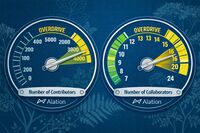
Appendix: each machine, rele dance, design, implementation and costing, automation capacity,
Inc lude Tom's shoes model for housing.
For example - housing is a rapid training RLF membership. The gym where you practice skills. And else have 1000 people going through the program each year. 10 facilities like this provide the needs of all dig builders. Paint a picture of this facility, with costs and deliverables, showing house build at $40k service fee if you build all the modules. Or the ADU biz model. All starts with Iconic CAD for real design where the person does their full build. Cost is materials + OSE fee. Revisit this as a viable model. We could provide a temp structure free from rain to make this happen on someone else's land without looking like a pigsty. Come up with all kinds of tactical example for how to do this. Include Tom
Extreme Collaboration Method
The extreme collaboration method involves BHAGs, such as opensourcing and thus distributing the wealth of entire sectors. Such as housing, or solar hydrogen, solar steel and concrete, windpower, and 3D printing. And many more. Total market size is 1/10 of the economy. Our further goal, once open collaboration is established, is to opensource the technosphere, a Knowledge Kernel that costs only $50B to release. The game is one not of technology, however, but of upgrading human minds into growth mindsets of abundance - with rigorous skills.
Here we start with Iconic CAD.
Extreme Collaboration means that you are also The Punisher. That means you work on identifying and eliminating things that are plain wrong based on moral compass.
Who We Need
True collaboration community optimizers. Paradox between optimizers and community, ie meaning and good life. Purpose is civilization grade. Explain civilization grade, from just minding your own business to doing civilization relevant work, namely moving the dial for humanity. This is effectively a prospectus for participants, and why this is not a bunch of hippies moving to the woods.
The Alternative
We are heading for technofeudalism and global instability if we don't do this. We'll all be moving to North Korea if w don't succeed. Keep an open mind to never split the difference, such as why Russia should have a say in the world in a multiple order. Connect this to big time geopolitics and their relevant theory summary. Summarize existing peacekeeping institutions and why the rich countries don't comply.
Green History of the World
We need to understand that nature destruction is not new in order to be more effective at current ecological solutions.
.
Applied Civilization Lab
Calista communicate a functional community built around an R&D campus as a desirable model of how people can solve the crisis of meaning and purpose in the digital age with agency and self determination for complete freedom and prosperity. Simply put a case for paradise and how it can be obtained using available modern technology and techniques today - while avoiding any notions of scarcity or reduced ambition for the progress of humanity
We are starting on the next step of our journey. We already showed that open source, industrial productivity - can be achieved - on a small scale. See TED Talk. We showed that lifetime design is required for technology to serve humans, as opposed to being dependent and damaged when things break. See Viral Video. We sold our first house, for $212k, so we can make revenue happen. We showed radical swarm build efficiency, such as th Seed Eco-Home 1 build in 5 days - with 50 unskilled people. We have done some agriculture, from perennial polyculture Miracle Orchard to Afforestt to Nut Planting, and have understood that Crop Yields Per Acre can range anywhere from $200 to $40B. So we are now doing an experiment where we build a real experiment of model civilization, built around an education campus. That means we are building infrastructure, energy, agriculture, manufacturing, governance, finance, health, security, education and other systems that make society work. By starting with opening knowhow, and creating replicable blueprints - for a model civilization in paradise. Many civilization startup have occurred, but none we know of that are based on a core of opening the economy to global collaboration. Starting from basic tech, and moving up to advanced tech, including spaceships and microchips in later phases. For now, the experiment starts with a founding cohort of 24 people living on site, building an ideal society - but that really means becoming burdened with infinite power for unlimited responsibility. This is not a walk in the park. We aim to define a datapoint for human possibility - and publish all the progress while we are at it.
Documentation Discipline
We publish on social media, and document designs on the wiki. We follow a simple procedure where everyone keeps a Work Log. This is used to document their work product as links, with typical development being a technology, enterprise, or institution of some sort - captured in the wiki Development Template that can be invoked with {{subst:dev+}}. This is our way to community transparency - as anyone can see what anyone else is doing transparently. And in 2026, AI made it possible to automate a key component of our work - Computer Aided Design - where now we are programming CAD using human language instead of tedious manipulation of objects on a screen. We are making it easy with a basic concept: break down technology into simple modules like Legos - assemble them in a drawing based on icons where icons correspond to real parts - and AI compiles these drawings into real, technically correct CAD! The requirement for this to work is first creating a part library of parts, and for each part, specifications that describe various aspects of its geometry and other properties - so for example - if you want an electrical box in your house design - you simply express a specification in human language such as I want a '2 outlet box at countettop level' - and AI will put that into the CAD. The process relies only on having a part library - and a design guide for basics of how some artifact is buils - so that any average human can build real things from the available part library and design rules found in the design guide. The design system has been worked out over years of OSE builds - and it builds upon the simple concept of modularity - where we break things down into parts, and define interfaces for how parts connect together.
Our 4 year immersion program, which starts with a 3 month Applied Civilization Lab session - teaches exactly how to engage in this process, and how to expand the part libraries so that any design in the world is possible. We are publishing design guides and part libraries for the Seed Eco-Home, machines, enterprises, systems, and everything else that makes civilization work. But the trick is - we are taking existing designs - and implementing them in the way we think would work better - as real, documented infrastructure builds at Factor e Farm - which is our first Applied Civilization Lab.
Growing the Experiment
We foresee growing Factor e Farm to 240 people. Each new cohort of 24 builds the on-site population, and as people gain skills, they are invited to more permanent roles and responsibilities on site. Each inductee takes on a specific areas of infrastructure - from the 24 Core Institutions
If we replicate, then it would take 8 years if we reinvest 50% of the new PV energy into PV manufacturing.
30 Acre Experiment
Energy/manufacturing/housing/agriculture infrastructure v1 - [1]
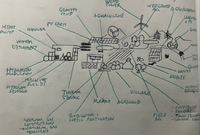 Link
Link
Include Expertise Embedded Design Principle to validate executability
Neo-subsistence Model
- Discuss Cost of Living - and the reality of most people on the planet living on $7 per day.
- Gini Coefficient discussion. Is it getting better or worse?
- And the base figure of top 12 people in the world having 1/2 of the wealth of the world. Is this way worse than feudalism?
- what is an honest assessment of The Better Angels of Our Nature? Gross crime against humanity decreased, but less people are happy and free today - in terms of true freedom?
- The new model of non-slabery comes.from being able to produce. The only last frontier is lowering taxes by efficiency, and decreasing regulation by responsibility. That is impossible - a perfect problem to take on in earnest. But it is actually simpler than it looks: Structural Governance for abundance: an incentive model for pro-social behavior. All we need to do is withdraw funding for crime against humanity.
Viral Replication
If the design is robust, expertise-embedded, inexpensive, open source, and replicable - we can scale.
Every 4 year graduate from our immersion program is getting trained to replicate a new campus exactly, certified for its various Integrated Enterprise certification. Whether a vertically integrated farm, integrated energy farm, micro factory, eco-indusyrial park - all will have an education component to bring open culture to a new level.
Let's Build Some Homes
Iconic CAD process. 19 modules - [2]
Key Economic Development Areas
Housing is an $11T global market, with $4T in residential alone. Opensourcing housing can make housing affordable, as major market control makes housing expensive [3]. To solve housing we propose the modular Seed Eco-Home, which can be reconfigured and redesigned for all types of size, shape, and performance - by average individuals using Iconic CAD. The end goal here is open design such that we catch up with all other animal species, which do not have a housing crisis outside of what humans may be causing.
Solar Hydrogen is a big one - hydrogen cracked from water by alkaline electrolysis - with payback times on the order of 4 months. This is a great study where growth of this could be extreme if distributed - as the total addressable market for fossil fuels, which hydrogen can replace - is about $6T. This could reduce resource conflict pressure worldwide, clean up the environment, and distribute 10% of global wealth. With housing, we could distribute 20% of all global wealth. The good thing about solar hydrogen is that the stack itself is $10k for 100kW - lends itself to non-hi tech manufacturing with off-the-shelf parts. The separator membranes are not exotic, unlike in more advanced proton exchange membrane electrolyzers - see Open Source Electrolyzer. The goal is to go off-grid for any new housing development by using Thermal Batteries and solar hydrogen. This means an effective ICE must be part of the equation.
Solar concrete is next. This builds infrastructure material from rock and solar electricity converted to resistive heat in Kanthal wire.
Dirt is next. Compressed Earth Blocks are still a great idea. Bulletproof and tornado proof, though if unstabilized, need to protect from rain.
From dirt comes food. Healthy food is a good idea, and growing it connects one to meaningful existence. So it is probably good if we grow at least some food ourselves.
Pure Passion: Freedom is the Goal
Connect libre tech to freedom with the most compelling argument, based on industry standards.
Discuss the inspiration of swarm-grade advanced R&D&P where devwloent velocity meets innovation. To do this, implement an advanced tech tourism class where we explore this with site visits, conferences, and SME search. See the promise of liberation by liberating technology - not just building homes - but up to solar cell manufacturing and space travel.
Freedom is the goal, so we should realize what Sartre called the 'curse of freedom'. Freedom is infinite power of will, with which comes infinite responsibility. But freedom is not possible without appropriate technology, ie, technology which serves human needs, not that which make us dependent, disempowered, or controlled. Democracy is not possible without liberated technology - where anyone has access to powerful tools, and where anyone can design or build what they want.
Freedom from taxation - one of the critical unsolved riddles of the economy - tax the robots! But who owns the robots? Responsible people. Robots make lots of $, so we can tax them. Get into an incisive analysis of post-labor, post-capital economy in an experimental node, framing the package as - at what scale (100-10000 or so) do we achieve post-labor, and at what scale can we achieve an economy of replication.
Platform: Sectoral Transformation
- Iconic CAD - distributed production digitized and democratized.
- Building a network of abundance nodes.
- Transforming current trends in a parallel system - taking each infrastructure of civilization and transforming it.
- Housing
- Energy
- Food
- Manufacturing
- Consumer goods - the distributive version of Amazon and Walmart.
- Governance
- Education
- AI Empire - a special case of its own.
- Finance - fake money vs backed money. Ethical economy transition, from the current state which is designed to do exactly what it does. The structural unemployment and exploitation thingy to post-work and post-capital abundance economy.
- Geopolitics - the economy in general, achieved above. Discuss how each element solves various issues as opposed to the current system of othering and man-hatin'
Adoption
I'm personally looking to adopt a few children. At best, it would be a million open source children who learn and practice abundance, the natural state of the world.
Macroeconomics
Big picture numbers and how Distributive Abundance Economics grows compared to big cap stocks. Examples of how fast economies of replication can grow compared to economies of scale, while remaining within the limits of physics.
Links

